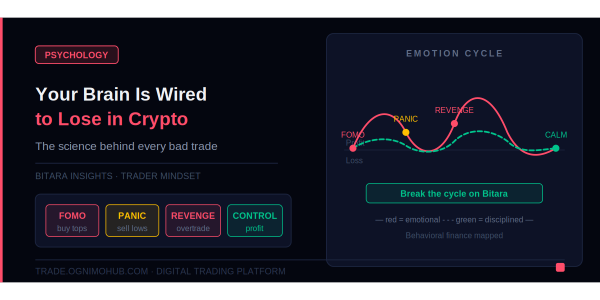
Your Brain Is Wired to Lose in Crypto — Here's the Science Behind Every Bad Trade You've Made
By Bitara Insights · May 2026 · 11 min read
The Uncomfortable Truth
Statistics consistently suggest that over 90% of day traders lose money in the long run. This is not because trading is impossible. It is because the structure of the human mind is fundamentally misaligned with the structure of probability — and crypto, with its 24/7 markets, extreme volatility, social media amplification, and leverage, is uniquely designed to exploit every cognitive weakness you have.
This is not a character flaw. The emotional responses that destroy trading accounts were adaptive evolutionary features for survival on the savanna. The problem is they are catastrophically maladaptive in a leveraged derivatives market.
Understanding the specific cognitive biases that trigger your worst trades is not self-help — it is edge. The traders who know their psychological attack surface and have built systems to defend it are the ones who are still in the market after five years.
The Five Biases That Destroy Crypto Accounts
1. FOMO — Fear of Missing Out
The mechanism: Your brain detects a potential reward it is about to miss. The amygdala fires. Cortisol and adrenaline spike. Rational analysis shuts down. Your hand moves toward the buy button before your prefrontal cortex can intervene.
How it plays out in crypto: Bitcoin traded between $85,000 and $90,000 for weeks in January 2026. You were waiting for a breakout. One night, BTC broke above $90,000 while you were sleeping. You woke up to BTC at $94,500. FOMO kicked in — you bought at $94,500, thinking the rally was just starting. Within 48 hours, BTC was back to $89,000. You bought the top, lost 5.8%, and watched from the sidelines as BTC consolidated for another two weeks.
This is not bad luck. It is the FOMO sequence running exactly as designed. Seeing a coin pump triggers a panic response. Traders jump into a long position at the top of a candle, entering exactly when the smart money is taking profit. In futures, entering late usually means your stop-loss is too wide to be sustainable.
The FOMO spiral runs like this: FOMO trigger → market buy at top → bad fill with 2–5% slippage → panic sets in → tight stop placed → stopped out → re-enter immediately → overtrade → account depletion. Every step is predictable. Every step is preventable.
The fix: Accept a fundamental truth — there is always another trade. Missing a move is not a loss. You lost nothing. The only way to lose is entering a bad trade, which is exactly what FOMO pushes you toward. Pre-commitment is the antidote: define your entry criteria when the market is calm, not when the chart is screaming green.
2. Loss Aversion — The Bias That Keeps Losing Trades Open
The mechanism: Behavioural economics research consistently finds that the pain of a loss is roughly twice as powerful as the pleasure of an equivalent gain. This asymmetry is not rational — it is neurological. Losses trigger the same threat-response circuitry as physical danger.
How it plays out in crypto: Loss aversion manifests as the refusal to close a losing trade. The position is down 15%. The thesis is invalidated. But closing means admitting you were wrong, and that admission feels physically unpleasant. So you move your stop wider. You tell yourself it will come back. You average down, doubling your exposure to a failing idea.
The loss aversion death spiral: loss aversion → refuse stop → average down → position size doubles → effective leverage increases → liquidation cascade → account destroyed.
This is one of the most common account-destroying patterns in leveraged crypto trading. What starts as a reasonable-sized loss becomes a catastrophic one because the same bias that created the loss (refusing to close) compounds it repeatedly.
The fix: The stop-loss is not just a risk management tool. It is a psychological prosthetic that removes your loss-averse brain from the decision. When you pre-set a stop before entering, the exit happens automatically at a level your rational mind chose — not at the level your emotional brain negotiates down to in real time.
3. Revenge Trading — The Most Dangerous Pattern in Crypto
The mechanism: After a painful loss, the urge to "make it back" immediately is overwhelming. This is anger-based trading. It leads to higher leverage and impulsive entries, usually resulting in a second, larger loss that wipes out the account.
How it plays out in crypto: You lose $200 on a well-planned trade. The market was wrong. You were right. You need to get that $200 back immediately because it feels like it belongs to you. You re-enter within minutes, this time with larger size because you need to recover faster. The market is now moving against you and you are not thinking clearly. The second loss is $400.
Revenge trading occurs when you take a loss and immediately jump back in trying to "win it back." Instead of following strategy, you are trading against the market to soothe your ego. The revenge trade is almost always oversized, poorly timed, and emotionally driven — compounding one loss into a catastrophic drawdown.
The revenge trading sequence: loss taken → emotional frustration → revenge trade at max leverage → larger loss or immediate liquidation → deposit more funds → repeat. This cycle ends one way — a depleted account and a depleted trader.
The fix: A cooldown rule. After any loss exceeding normal risk, or after two consecutive losses, step away for at least 30 minutes. Some traders walk away for the rest of the day. This is not weakness — it is discipline. The market will be there tomorrow. There is no trade so urgent it cannot wait until your head is clear.
Establish a hard rule: if you lose a defined percentage of your account in a single day — say 3–5% — you are done trading for that calendar day. No exceptions. The market will be open tomorrow. Your capital might not recover if you stay.
4. Overconfidence — The Winning Streak That Destroys You
The mechanism: After a series of successful trades, the brain floods with dopamine and constructs a narrative: "I understand this market. I am good at this." Risk tolerance quietly expands. Position sizes grow. The winning streak is attributed to skill. The losses that follow are attributed to bad luck.
How it plays out in crypto: The winner's curse: win streak → overconfidence → oversized position → normal loss wipes multiple wins → loss aversion holds through → extended drawdown.
This pattern is particularly brutal because the overconfidence is reinforced by genuine success. You made five good trades in a row. Those trades were real. But the overconfidence they generated caused you to size up into a sixth trade that gave back all five wins in a single position.
Statistically, even a strategy with a 60% win rate will produce streaks of five or more consecutive losses approximately 1.3% of the time over 500 trades. When losses cluster after a winning streak, most retail traders interpret the streak as evidence that their edge has disappeared, triggering panic-driven strategy abandonment or position size escalation in revenge trading cycles.
The fix: Position size rules must be fixed and disconnected from recent performance. If your rule is 1% risk per trade, that rule applies whether you have won ten in a row or lost five in a row. Never let recent outcomes change your sizing formula.
5. Confirmation Bias — Trading the Story, Not the Market
The mechanism: The brain naturally seeks information that confirms existing beliefs and discounts information that contradicts them. In trading, this manifests as "narrative capture" — you form a view (BTC is going to $150k), and then your information consumption becomes a curated feed of evidence supporting that view.
How it plays out in crypto: You are long BTC at $98,000. You see a bearish divergence on the 4-hour chart. Your brain dismisses it because it contradicts your bullish thesis. You see a bullish tweet from a prominent analyst. You screenshot it and add it to your conviction. The divergence plays out. You are down 12%.
Social media amplifies this bias catastrophically. Doom-scrolling X and Telegram — your feed starts steering your entries. The crypto social media ecosystem is specifically optimised to reinforce whatever thesis generates the most engagement, not whatever thesis is correct.
The fix: Actively seek disconfirming evidence. Before entering a trade, spend five minutes looking for the strongest possible case against your thesis. Write down what would prove you wrong. Set a price level at which you admit your thesis is invalidated — and honour it.
The Liquidation Spiral: A Psychological Trap Unique to Leveraged Markets
The "Liquidation Spiral" is a phenomenon specific to leveraged markets that creates extreme psychological distress.
Here is how it works: a large move triggers a wave of liquidations. Those liquidations add selling pressure. The additional selling triggers more liquidations. The cascade accelerates. Traders watching their positions get liquidated experience panic responses so intense that the physiological state is indistinguishable from physical danger.
In this state, rational decision-making is neurologically impossible. The prefrontal cortex — where analysis happens — goes offline. Decisions are made by the same brain structures that evolved to run from predators. These decisions are almost always wrong.
The practical implication: when markets are in a liquidation cascade, the correct action for a leveraged trader is almost always to do nothing, or to exit. The emotional pull is to add to positions, chase the reversal, or revenge trade the volatility. This is exactly the wrong response, and the neurological explanation for why 182,000 traders were liquidated in a single day in January 2026.
Building Your Psychological Defence System
Understanding the biases is necessary but insufficient. You need systems that work when your rational mind is offline — which is precisely when it matters most.
The Trading Plan Rule
Every trade must have a written plan before entry: entry price, stop-loss level, take-profit target, position size, and the thesis in one sentence. If you cannot articulate the thesis in one sentence, you do not have a trade — you have a feeling.
The Pre-Commitment Principle
The most effective antidote to emotional decision-making is removing the decision from the moment of emotional pressure. Set conditional orders. Write down your thesis when the market is neutral. By the time the crowd is screaming, your trades should already be placed.
The Daily Loss Limit
Establish a hard rule for daily losses. If you lose a defined percentage of your account in a single day, you are banned from trading for 24 hours. Physically leave the screen. This rule has one purpose: preventing the revenge trading sequence from compounding a manageable loss into an account-destroying one.
The Cooldown Protocol
After any significant loss — define "significant" in advance as a specific dollar amount — implement a mandatory 30-minute minimum cooldown before the next trade. Use this time to eat something, walk outside, or do anything that is not staring at charts. The physiological stress response takes approximately 20–30 minutes to clear. You cannot make good decisions until it does.
The Journal Practice
Every trade — win or lose — should be logged with: entry thesis, outcome, and emotional state during the trade. After 30–50 trades, review the journal. You will almost certainly find that your worst losses correlate with specific emotional states: revenge, FOMO, overconfidence. The data from your own journal is the most powerful feedback available. Behavioral decision making improves through feedback.
The Paradox of Discipline
Here is the insight that separates the 10% of traders who are consistently profitable from the 90% who are not: discipline is not about suppressing emotions. It is about designing systems that make the right decision automatic when emotions are highest.
The professional trader who has been in the market for five years is not emotionally detached. They still feel the sting of a stop getting hit. They still feel the pull of FOMO during a parabolic move. What is different is that their pre-trade checklists, their position sizing rules, their daily loss limits, and their cooldown protocols have made the right response automatic — a sequence of actions that executes regardless of what they are feeling in the moment.
That infrastructure takes time to build. But it is available to any trader who is willing to study their own patterns honestly and build rules that protect them from their own worst impulses.
Bitara gives you the tools. The psychological edge is yours to develop.
Share This Post
By Bitara Insights · May 2026 · 11 min read
The Uncomfortable Truth
Statistics consistently suggest that over 90% of day traders lose money in the long run. This is not because trading is impossible. It is because the structure of the human mind is fundamentally misaligned with the structure of probability — and crypto, with its 24/7 markets, extreme volatility, social media amplification, and leverage, is uniquely designed to exploit every cognitive weakness you have.
This is not a character flaw. The emotional responses that destroy trading accounts were adaptive evolutionary features for survival on the savanna. The problem is they are catastrophically maladaptive in a leveraged derivatives market.
Understanding the specific cognitive biases that trigger your worst trades is not self-help — it is edge. The traders who know their psychological attack surface and have built systems to defend it are the ones who are still in the market after five years.
The Five Biases That Destroy Crypto Accounts
1. FOMO — Fear of Missing Out
The mechanism: Your brain detects a potential reward it is about to miss. The amygdala fires. Cortisol and adrenaline spike. Rational analysis shuts down. Your hand moves toward the buy button before your prefrontal cortex can intervene.
How it plays out in crypto: Bitcoin traded between $85,000 and $90,000 for weeks in January 2026. You were waiting for a breakout. One night, BTC broke above $90,000 while you were sleeping. You woke up to BTC at $94,500. FOMO kicked in — you bought at $94,500, thinking the rally was just starting. Within 48 hours, BTC was back to $89,000. You bought the top, lost 5.8%, and watched from the sidelines as BTC consolidated for another two weeks.
This is not bad luck. It is the FOMO sequence running exactly as designed. Seeing a coin pump triggers a panic response. Traders jump into a long position at the top of a candle, entering exactly when the smart money is taking profit. In futures, entering late usually means your stop-loss is too wide to be sustainable.
The FOMO spiral runs like this: FOMO trigger → market buy at top → bad fill with 2–5% slippage → panic sets in → tight stop placed → stopped out → re-enter immediately → overtrade → account depletion. Every step is predictable. Every step is preventable.
The fix: Accept a fundamental truth — there is always another trade. Missing a move is not a loss. You lost nothing. The only way to lose is entering a bad trade, which is exactly what FOMO pushes you toward. Pre-commitment is the antidote: define your entry criteria when the market is calm, not when the chart is screaming green.
2. Loss Aversion — The Bias That Keeps Losing Trades Open
The mechanism: Behavioural economics research consistently finds that the pain of a loss is roughly twice as powerful as the pleasure of an equivalent gain. This asymmetry is not rational — it is neurological. Losses trigger the same threat-response circuitry as physical danger.
How it plays out in crypto: Loss aversion manifests as the refusal to close a losing trade. The position is down 15%. The thesis is invalidated. But closing means admitting you were wrong, and that admission feels physically unpleasant. So you move your stop wider. You tell yourself it will come back. You average down, doubling your exposure to a failing idea.
The loss aversion death spiral: loss aversion → refuse stop → average down → position size doubles → effective leverage increases → liquidation cascade → account destroyed.
This is one of the most common account-destroying patterns in leveraged crypto trading. What starts as a reasonable-sized loss becomes a catastrophic one because the same bias that created the loss (refusing to close) compounds it repeatedly.
The fix: The stop-loss is not just a risk management tool. It is a psychological prosthetic that removes your loss-averse brain from the decision. When you pre-set a stop before entering, the exit happens automatically at a level your rational mind chose — not at the level your emotional brain negotiates down to in real time.
3. Revenge Trading — The Most Dangerous Pattern in Crypto
The mechanism: After a painful loss, the urge to "make it back" immediately is overwhelming. This is anger-based trading. It leads to higher leverage and impulsive entries, usually resulting in a second, larger loss that wipes out the account.
How it plays out in crypto: You lose $200 on a well-planned trade. The market was wrong. You were right. You need to get that $200 back immediately because it feels like it belongs to you. You re-enter within minutes, this time with larger size because you need to recover faster. The market is now moving against you and you are not thinking clearly. The second loss is $400.
Revenge trading occurs when you take a loss and immediately jump back in trying to "win it back." Instead of following strategy, you are trading against the market to soothe your ego. The revenge trade is almost always oversized, poorly timed, and emotionally driven — compounding one loss into a catastrophic drawdown.
The revenge trading sequence: loss taken → emotional frustration → revenge trade at max leverage → larger loss or immediate liquidation → deposit more funds → repeat. This cycle ends one way — a depleted account and a depleted trader.
The fix: A cooldown rule. After any loss exceeding normal risk, or after two consecutive losses, step away for at least 30 minutes. Some traders walk away for the rest of the day. This is not weakness — it is discipline. The market will be there tomorrow. There is no trade so urgent it cannot wait until your head is clear.
Establish a hard rule: if you lose a defined percentage of your account in a single day — say 3–5% — you are done trading for that calendar day. No exceptions. The market will be open tomorrow. Your capital might not recover if you stay.
4. Overconfidence — The Winning Streak That Destroys You
The mechanism: After a series of successful trades, the brain floods with dopamine and constructs a narrative: "I understand this market. I am good at this." Risk tolerance quietly expands. Position sizes grow. The winning streak is attributed to skill. The losses that follow are attributed to bad luck.
How it plays out in crypto: The winner's curse: win streak → overconfidence → oversized position → normal loss wipes multiple wins → loss aversion holds through → extended drawdown.
This pattern is particularly brutal because the overconfidence is reinforced by genuine success. You made five good trades in a row. Those trades were real. But the overconfidence they generated caused you to size up into a sixth trade that gave back all five wins in a single position.
Statistically, even a strategy with a 60% win rate will produce streaks of five or more consecutive losses approximately 1.3% of the time over 500 trades. When losses cluster after a winning streak, most retail traders interpret the streak as evidence that their edge has disappeared, triggering panic-driven strategy abandonment or position size escalation in revenge trading cycles.
The fix: Position size rules must be fixed and disconnected from recent performance. If your rule is 1% risk per trade, that rule applies whether you have won ten in a row or lost five in a row. Never let recent outcomes change your sizing formula.
5. Confirmation Bias — Trading the Story, Not the Market
The mechanism: The brain naturally seeks information that confirms existing beliefs and discounts information that contradicts them. In trading, this manifests as "narrative capture" — you form a view (BTC is going to $150k), and then your information consumption becomes a curated feed of evidence supporting that view.
How it plays out in crypto: You are long BTC at $98,000. You see a bearish divergence on the 4-hour chart. Your brain dismisses it because it contradicts your bullish thesis. You see a bullish tweet from a prominent analyst. You screenshot it and add it to your conviction. The divergence plays out. You are down 12%.
Social media amplifies this bias catastrophically. Doom-scrolling X and Telegram — your feed starts steering your entries. The crypto social media ecosystem is specifically optimised to reinforce whatever thesis generates the most engagement, not whatever thesis is correct.
The fix: Actively seek disconfirming evidence. Before entering a trade, spend five minutes looking for the strongest possible case against your thesis. Write down what would prove you wrong. Set a price level at which you admit your thesis is invalidated — and honour it.
The Liquidation Spiral: A Psychological Trap Unique to Leveraged Markets
The "Liquidation Spiral" is a phenomenon specific to leveraged markets that creates extreme psychological distress.
Here is how it works: a large move triggers a wave of liquidations. Those liquidations add selling pressure. The additional selling triggers more liquidations. The cascade accelerates. Traders watching their positions get liquidated experience panic responses so intense that the physiological state is indistinguishable from physical danger.
In this state, rational decision-making is neurologically impossible. The prefrontal cortex — where analysis happens — goes offline. Decisions are made by the same brain structures that evolved to run from predators. These decisions are almost always wrong.
The practical implication: when markets are in a liquidation cascade, the correct action for a leveraged trader is almost always to do nothing, or to exit. The emotional pull is to add to positions, chase the reversal, or revenge trade the volatility. This is exactly the wrong response, and the neurological explanation for why 182,000 traders were liquidated in a single day in January 2026.
Building Your Psychological Defence System
Understanding the biases is necessary but insufficient. You need systems that work when your rational mind is offline — which is precisely when it matters most.
The Trading Plan Rule
Every trade must have a written plan before entry: entry price, stop-loss level, take-profit target, position size, and the thesis in one sentence. If you cannot articulate the thesis in one sentence, you do not have a trade — you have a feeling.
The Pre-Commitment Principle
The most effective antidote to emotional decision-making is removing the decision from the moment of emotional pressure. Set conditional orders. Write down your thesis when the market is neutral. By the time the crowd is screaming, your trades should already be placed.
The Daily Loss Limit
Establish a hard rule for daily losses. If you lose a defined percentage of your account in a single day, you are banned from trading for 24 hours. Physically leave the screen. This rule has one purpose: preventing the revenge trading sequence from compounding a manageable loss into an account-destroying one.
The Cooldown Protocol
After any significant loss — define "significant" in advance as a specific dollar amount — implement a mandatory 30-minute minimum cooldown before the next trade. Use this time to eat something, walk outside, or do anything that is not staring at charts. The physiological stress response takes approximately 20–30 minutes to clear. You cannot make good decisions until it does.
The Journal Practice
Every trade — win or lose — should be logged with: entry thesis, outcome, and emotional state during the trade. After 30–50 trades, review the journal. You will almost certainly find that your worst losses correlate with specific emotional states: revenge, FOMO, overconfidence. The data from your own journal is the most powerful feedback available. Behavioral decision making improves through feedback.
The Paradox of Discipline
Here is the insight that separates the 10% of traders who are consistently profitable from the 90% who are not: discipline is not about suppressing emotions. It is about designing systems that make the right decision automatic when emotions are highest.
The professional trader who has been in the market for five years is not emotionally detached. They still feel the sting of a stop getting hit. They still feel the pull of FOMO during a parabolic move. What is different is that their pre-trade checklists, their position sizing rules, their daily loss limits, and their cooldown protocols have made the right response automatic — a sequence of actions that executes regardless of what they are feeling in the moment.
That infrastructure takes time to build. But it is available to any trader who is willing to study their own patterns honestly and build rules that protect them from their own worst impulses.
Bitara gives you the tools. The psychological edge is yours to develop.