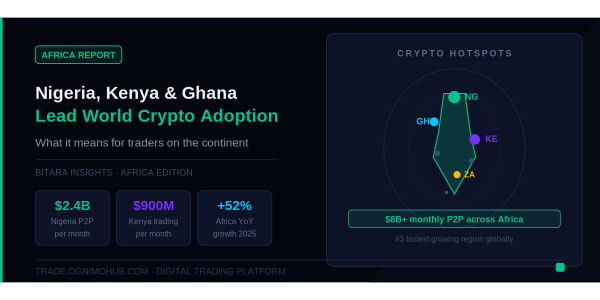
Why Nigeria, Kenya and Ghana Are Leading the World in Crypto Adoption — And What It Means for You
By Bitara Insights · Africa Edition · May 2026 · 12 min read
Africa Did Not Follow the Crypto Playbook. It Rewrote It.
In Western markets, crypto adoption followed a predictable arc: early tech adopters, then speculative retail investors, then institutional capital. The narrative was always financial innovation — a new asset class for portfolios that already worked.
In Africa, it was different. Crypto adoption here was not driven by innovation enthusiasm. It was driven by necessity. By a working-age population locked out of dollar accounts while watching their local currency lose 60–70% of its value. By remittance recipients paying 8–12% to Western Union for money that took three days to arrive. By small business owners who could not get US dollars from their banks to pay international suppliers.
In Africa in 2026, crypto is not speculative entertainment. It is operational financial infrastructure. And three countries — Nigeria, Kenya, and Ghana — are leading not just Africa, but the entire world in grassroots crypto adoption.
The Numbers That Tell the Story
Between July 2024 and June 2025, Sub-Saharan Africa received more than $205 billion in on-chain value, a 52% year-over-year increase that placed the region among the world's fastest-growing crypto markets.
The 2026 Global Crypto Adoption Index ranks 151 countries across four sub-indexes. India holds #1, Nigeria rises to #2, and Ethiopia, Kenya, and Ghana debut in the top 20 as stablecoin adoption surges 180% across Sub-Saharan Africa.
Nigeria leads African cryptocurrency trading with monthly volumes exceeding $2.4 billion as of 2026, driven by peer-to-peer platforms and high adoption among youth demographics. South Africa follows with approximately $1.8 billion in monthly trading. Kenya ranks third with over $900 million monthly, leveraging mobile money integration for seamless fiat on-ramps.
These are not numbers from an emerging market slowly catching up. These are numbers that place African countries at the top of global adoption rankings — ahead of the United States, ahead of Germany, ahead of Japan.
Nigeria: The World's P2P Capital
Nigeria's crypto story begins not in a fintech startup but in economic survival. In countries like Nigeria, where the naira has depreciated dramatically — from around NGN 360 per US dollar in 2019 to over NGN 1,400 per US dollar by 2024 — the pressure on ordinary Nigerians to find alternative stores of value has been immense.
By 2021 and 2022, crypto had gone mainstream in Nigeria. Reports showed that 35 percent of adults were now crypto investors, and more than half of them were under 30 years old. This was not institutional adoption driven by portfolio theory. This was millions of young Nigerians using crypto to protect savings, receive international payments, and participate in an economy their local banking system was failing to serve.
Chainalysis estimates about $59 billion in cryptocurrency transaction volume passed through Nigeria in 2024. Stablecoins make up an estimated 40 percent of Nigeria's crypto market, led by dollar-pegged tokens like USDT and USDC. Stablecoin use is also driven by crypto remittances — Nigeria was Africa's largest remittance recipient in 2023, with about $19.5 billion received according to the World Bank.
The dominant driver is straightforward. Roughly 70 percent of African countries are experiencing FX shortages that make it difficult for businesses to obtain the US dollars they need to operate. Crypto — specifically USDT — is the workaround. It bypasses the Central Bank queue entirely.
Nigeria's regulatory journey has been turbulent — the CBN has alternated between restricting and permitting crypto activity throughout the 2020s. Nigeria issued 25 virtual asset licenses under the regulatory sandbox model by 2026, signalling a shift toward accommodation rather than resistance. The direction of travel is toward formalisation, not suppression.
What this means for Bitara traders in Nigeria: P2P trading is not a feature — it is the primary on-ramp. Bitara's P2P marketplace connects Nigerian traders directly, enabling naira-to-USDT and naira-to-BTC transactions without bank intermediaries. The volume is there. The demand is structural.
Kenya: Where Mobile Money Meets Crypto
Kenya's crypto story is different from Nigeria's — and in many ways more sophisticated. With a population of 55 million and more mobile phone subscriptions per capita than the United States, Kenya has long led the region in digital finance adoption. As of 2021, 79 percent of Kenyan adults had some form of financial account, largely due to mobile money like Safaricom's pioneering M-Pesa, which uses SMS and mobile phones to provide accessible digital payments.
M-Pesa did something remarkable: it taught an entire population to transact digitally before smartphones were ubiquitous. That foundation made the leap to crypto uniquely frictionless in Kenya. Where other countries had to teach users to trust digital money, Kenya already had a generation comfortable with it.
Kenya edged toward formal crypto regulation in 2025 when its parliament passed a Virtual Asset Service Provider (VASP) bill establishing a licensing framework. This matters enormously. It means Kenya is not trying to suppress crypto — it is building the infrastructure to regulate and grow it. The $900 million in monthly trading volume will grow substantially as the regulatory framework makes institutional participation safer.
Kenya's BitPesa Wallet serves 6.5 million people for remittances — a number that reflects the depth of demand for alternative payment infrastructure. For East African traders, Kenya is both a model market and the regional hub.
What this means for Bitara traders in Kenya: The M-Pesa integration with P2P crypto is the most natural pairing in African fintech. Traders who can move between M-Pesa and USDT seamlessly have access to one of the most liquid P2P corridors on the continent. Bitara's East Africa gateway connects Kenyan users directly to this infrastructure.
Ghana: The Sleeping Giant Wakes
Ghana has quietly built one of Africa's most crypto-literate populations. According to research and current data, nearly 3 million Ghanaians are using cryptocurrency right now — a remarkable penetration rate for a country of 33 million.
Ghana's crypto adoption has been driven by similar forces to Nigeria — currency instability, remittance demand, and a young population actively seeking financial alternatives — but with a crucial difference: Ghana's regulatory environment has been less hostile. The Bank of Ghana has taken a more measured "watch and engage" approach, and Ghana now requires virtual asset providers to register ahead of broader guidance, indicating a structured regulatory approach rather than a blanket restriction.
Ghana also benefits from a strong fintech ecosystem and one of West Africa's most educated urban populations. The combination of financial literacy, mobile penetration, and structural currency pressure creates strong conditions for continued crypto growth.
What this means for Bitara traders in Ghana: Ghana represents one of the fastest-growing P2P markets in West Africa. The combination of regulatory openness and strong demand makes it a priority growth market for platforms like Bitara.
The Real Driver: Why This Is Structural, Not Speculative
It is tempting to frame African crypto adoption as a speculative wave that will recede when the bull market ends. The data does not support this. Dollar-pegged stablecoins function as de facto working-capital instruments for businesses that cannot get dollars from their banks. Bitcoin functions as a store of value in inflation environments where the local currency does not. DeFi protocols function as lending platforms in markets with thin formal credit.
These use cases do not go away when Bitcoin's price corrects. A business that uses USDT to pay a Chinese supplier is not going to abandon USDT because BTC dropped 30%. A Nigerian trader who converted savings from naira to USDT is not going to convert back to an asset losing 3% per month to inflation.
Crypto adoption in Africa looks fundamentally different from Western markets. Instead of desktop trading platforms or complex financial products, users in Africa prefer mobile wallets, P2P marketplaces, and social trading communities. This preference profile is not a limitation — it is a product specification. Platforms that serve the actual behaviour of African crypto users, rather than trying to replicate Western institutional interfaces, will capture the growth.
Africa accounts for 70% of the world's $1 trillion mobile money market. The integration of mobile money with crypto is not a technical curiosity — it is the most important fintech development of the next decade.
The Regulation Picture in 2026
Africa's crypto adoption jumped 52% year-on-year with $205 billion in on-chain value as South Africa, Nigeria, Kenya, and Mauritius advance crypto regulation in 2026.
South Africa has emerged as one of the continent's early leaders in crypto regulation. Beginning in June 2023, the country implemented a comprehensive framework classifying crypto assets as financial products. Under this regime, Crypto Asset Service Providers (CASPs) must obtain licenses and comply with oversight from the Financial Sector Conduct Authority and the Financial Intelligence Centre.
Refined frameworks in influential economies like South Africa, Nigeria and Kenya could serve as models for other nations. Moreover, cross-border fintech initiatives and collaboration are creating a more harmonized overall ecosystem.
The regulatory trajectory is clear: Africa is moving from informal tolerance to formal frameworks. This progression is the most important structural driver for institutional crypto adoption on the continent in 2027 and beyond.
What This Means for Your Trading on Bitara
Africa's crypto market is not a peripheral story. It is the world's fastest-growing crypto adoption story, backed by structural demand that exists regardless of market cycles.
For Bitara traders, this translates into specific opportunities:
P2P trading premium: Currency volatility in Nigeria, Kenya, and Ghana means P2P traders who can provide liquidity earn a spread that does not exist in stable-currency markets. The premium for being a reliable P2P counterparty in these markets is real and sustainable.
Stablecoin demand: The structural dollar shortage across West and East Africa means USDT demand is durable. Traders who understand stablecoin corridors — the premium at which USDT trades against local currencies — have a genuine information edge.
Copy trading for African market access: Following lead traders who specialise in African market dynamics — P2P arbitrage, regional token adoption cycles — provides exposure to return profiles that are uncorrelated with Western market sentiment.
Early positioning in regulatory unlocks: As Nigeria, Kenya, and South Africa finalise their regulatory frameworks, institutional capital will flow into these markets. The traders who are already positioned and active in these corridors will benefit from the liquidity injection that follows formal regulation.
Africa is not catching up. In grassroots adoption, it is already ahead.
Disclaimer: This content is for informational and educational purposes only and does not constitute financial advice. Always conduct your own research before trading.
Share This Post
By Bitara Insights · Africa Edition · May 2026 · 12 min read
Africa Did Not Follow the Crypto Playbook. It Rewrote It.
In Western markets, crypto adoption followed a predictable arc: early tech adopters, then speculative retail investors, then institutional capital. The narrative was always financial innovation — a new asset class for portfolios that already worked.
In Africa, it was different. Crypto adoption here was not driven by innovation enthusiasm. It was driven by necessity. By a working-age population locked out of dollar accounts while watching their local currency lose 60–70% of its value. By remittance recipients paying 8–12% to Western Union for money that took three days to arrive. By small business owners who could not get US dollars from their banks to pay international suppliers.
In Africa in 2026, crypto is not speculative entertainment. It is operational financial infrastructure. And three countries — Nigeria, Kenya, and Ghana — are leading not just Africa, but the entire world in grassroots crypto adoption.
The Numbers That Tell the Story
Between July 2024 and June 2025, Sub-Saharan Africa received more than $205 billion in on-chain value, a 52% year-over-year increase that placed the region among the world's fastest-growing crypto markets.
The 2026 Global Crypto Adoption Index ranks 151 countries across four sub-indexes. India holds #1, Nigeria rises to #2, and Ethiopia, Kenya, and Ghana debut in the top 20 as stablecoin adoption surges 180% across Sub-Saharan Africa.
Nigeria leads African cryptocurrency trading with monthly volumes exceeding $2.4 billion as of 2026, driven by peer-to-peer platforms and high adoption among youth demographics. South Africa follows with approximately $1.8 billion in monthly trading. Kenya ranks third with over $900 million monthly, leveraging mobile money integration for seamless fiat on-ramps.
These are not numbers from an emerging market slowly catching up. These are numbers that place African countries at the top of global adoption rankings — ahead of the United States, ahead of Germany, ahead of Japan.
Nigeria: The World's P2P Capital
Nigeria's crypto story begins not in a fintech startup but in economic survival. In countries like Nigeria, where the naira has depreciated dramatically — from around NGN 360 per US dollar in 2019 to over NGN 1,400 per US dollar by 2024 — the pressure on ordinary Nigerians to find alternative stores of value has been immense.
By 2021 and 2022, crypto had gone mainstream in Nigeria. Reports showed that 35 percent of adults were now crypto investors, and more than half of them were under 30 years old. This was not institutional adoption driven by portfolio theory. This was millions of young Nigerians using crypto to protect savings, receive international payments, and participate in an economy their local banking system was failing to serve.
Chainalysis estimates about $59 billion in cryptocurrency transaction volume passed through Nigeria in 2024. Stablecoins make up an estimated 40 percent of Nigeria's crypto market, led by dollar-pegged tokens like USDT and USDC. Stablecoin use is also driven by crypto remittances — Nigeria was Africa's largest remittance recipient in 2023, with about $19.5 billion received according to the World Bank.
The dominant driver is straightforward. Roughly 70 percent of African countries are experiencing FX shortages that make it difficult for businesses to obtain the US dollars they need to operate. Crypto — specifically USDT — is the workaround. It bypasses the Central Bank queue entirely.
Nigeria's regulatory journey has been turbulent — the CBN has alternated between restricting and permitting crypto activity throughout the 2020s. Nigeria issued 25 virtual asset licenses under the regulatory sandbox model by 2026, signalling a shift toward accommodation rather than resistance. The direction of travel is toward formalisation, not suppression.
What this means for Bitara traders in Nigeria: P2P trading is not a feature — it is the primary on-ramp. Bitara's P2P marketplace connects Nigerian traders directly, enabling naira-to-USDT and naira-to-BTC transactions without bank intermediaries. The volume is there. The demand is structural.
Kenya: Where Mobile Money Meets Crypto
Kenya's crypto story is different from Nigeria's — and in many ways more sophisticated. With a population of 55 million and more mobile phone subscriptions per capita than the United States, Kenya has long led the region in digital finance adoption. As of 2021, 79 percent of Kenyan adults had some form of financial account, largely due to mobile money like Safaricom's pioneering M-Pesa, which uses SMS and mobile phones to provide accessible digital payments.
M-Pesa did something remarkable: it taught an entire population to transact digitally before smartphones were ubiquitous. That foundation made the leap to crypto uniquely frictionless in Kenya. Where other countries had to teach users to trust digital money, Kenya already had a generation comfortable with it.
Kenya edged toward formal crypto regulation in 2025 when its parliament passed a Virtual Asset Service Provider (VASP) bill establishing a licensing framework. This matters enormously. It means Kenya is not trying to suppress crypto — it is building the infrastructure to regulate and grow it. The $900 million in monthly trading volume will grow substantially as the regulatory framework makes institutional participation safer.
Kenya's BitPesa Wallet serves 6.5 million people for remittances — a number that reflects the depth of demand for alternative payment infrastructure. For East African traders, Kenya is both a model market and the regional hub.
What this means for Bitara traders in Kenya: The M-Pesa integration with P2P crypto is the most natural pairing in African fintech. Traders who can move between M-Pesa and USDT seamlessly have access to one of the most liquid P2P corridors on the continent. Bitara's East Africa gateway connects Kenyan users directly to this infrastructure.
Ghana: The Sleeping Giant Wakes
Ghana has quietly built one of Africa's most crypto-literate populations. According to research and current data, nearly 3 million Ghanaians are using cryptocurrency right now — a remarkable penetration rate for a country of 33 million.
Ghana's crypto adoption has been driven by similar forces to Nigeria — currency instability, remittance demand, and a young population actively seeking financial alternatives — but with a crucial difference: Ghana's regulatory environment has been less hostile. The Bank of Ghana has taken a more measured "watch and engage" approach, and Ghana now requires virtual asset providers to register ahead of broader guidance, indicating a structured regulatory approach rather than a blanket restriction.
Ghana also benefits from a strong fintech ecosystem and one of West Africa's most educated urban populations. The combination of financial literacy, mobile penetration, and structural currency pressure creates strong conditions for continued crypto growth.
What this means for Bitara traders in Ghana: Ghana represents one of the fastest-growing P2P markets in West Africa. The combination of regulatory openness and strong demand makes it a priority growth market for platforms like Bitara.
The Real Driver: Why This Is Structural, Not Speculative
It is tempting to frame African crypto adoption as a speculative wave that will recede when the bull market ends. The data does not support this. Dollar-pegged stablecoins function as de facto working-capital instruments for businesses that cannot get dollars from their banks. Bitcoin functions as a store of value in inflation environments where the local currency does not. DeFi protocols function as lending platforms in markets with thin formal credit.
These use cases do not go away when Bitcoin's price corrects. A business that uses USDT to pay a Chinese supplier is not going to abandon USDT because BTC dropped 30%. A Nigerian trader who converted savings from naira to USDT is not going to convert back to an asset losing 3% per month to inflation.
Crypto adoption in Africa looks fundamentally different from Western markets. Instead of desktop trading platforms or complex financial products, users in Africa prefer mobile wallets, P2P marketplaces, and social trading communities. This preference profile is not a limitation — it is a product specification. Platforms that serve the actual behaviour of African crypto users, rather than trying to replicate Western institutional interfaces, will capture the growth.
Africa accounts for 70% of the world's $1 trillion mobile money market. The integration of mobile money with crypto is not a technical curiosity — it is the most important fintech development of the next decade.
The Regulation Picture in 2026
Africa's crypto adoption jumped 52% year-on-year with $205 billion in on-chain value as South Africa, Nigeria, Kenya, and Mauritius advance crypto regulation in 2026.
South Africa has emerged as one of the continent's early leaders in crypto regulation. Beginning in June 2023, the country implemented a comprehensive framework classifying crypto assets as financial products. Under this regime, Crypto Asset Service Providers (CASPs) must obtain licenses and comply with oversight from the Financial Sector Conduct Authority and the Financial Intelligence Centre.
Refined frameworks in influential economies like South Africa, Nigeria and Kenya could serve as models for other nations. Moreover, cross-border fintech initiatives and collaboration are creating a more harmonized overall ecosystem.
The regulatory trajectory is clear: Africa is moving from informal tolerance to formal frameworks. This progression is the most important structural driver for institutional crypto adoption on the continent in 2027 and beyond.
What This Means for Your Trading on Bitara
Africa's crypto market is not a peripheral story. It is the world's fastest-growing crypto adoption story, backed by structural demand that exists regardless of market cycles.
For Bitara traders, this translates into specific opportunities:
P2P trading premium: Currency volatility in Nigeria, Kenya, and Ghana means P2P traders who can provide liquidity earn a spread that does not exist in stable-currency markets. The premium for being a reliable P2P counterparty in these markets is real and sustainable.
Stablecoin demand: The structural dollar shortage across West and East Africa means USDT demand is durable. Traders who understand stablecoin corridors — the premium at which USDT trades against local currencies — have a genuine information edge.
Copy trading for African market access: Following lead traders who specialise in African market dynamics — P2P arbitrage, regional token adoption cycles — provides exposure to return profiles that are uncorrelated with Western market sentiment.
Early positioning in regulatory unlocks: As Nigeria, Kenya, and South Africa finalise their regulatory frameworks, institutional capital will flow into these markets. The traders who are already positioned and active in these corridors will benefit from the liquidity injection that follows formal regulation.
Africa is not catching up. In grassroots adoption, it is already ahead.
Disclaimer: This content is for informational and educational purposes only and does not constitute financial advice. Always conduct your own research before trading.