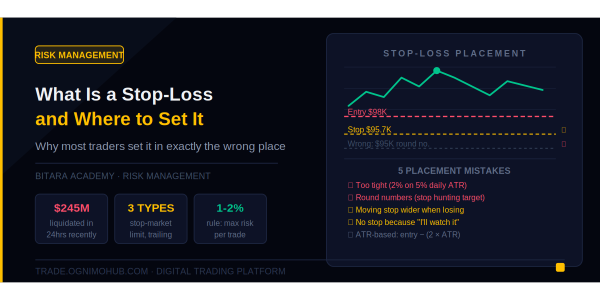
What Is a Stop-Loss and Why Most Crypto Traders Set It in Exactly the Wrong Place
By Bitara Academy · June 2026 · 11 min read
The Tool That Separates Professionals From Amateurs
There is one difference between a trader who blows their account and one who survives long enough to become consistently profitable: the second trader always uses a stop-loss, and they know exactly how to place it.
Last week, $245 million in leveraged crypto positions were liquidated in a single 24-hour window. Almost all of those liquidations involved either no stop-loss at all, or a stop-loss placed so poorly it might as well not have existed. The market did not do anything unusual. It moved the way crypto always moves. The traders who got liquidated simply had no protection in place.
This post teaches you everything about stop-losses — what they are, the different types, how to place them correctly, and the specific mistakes that turn a manageable loss into an account-destroying event.
What a Stop-Loss Actually Is
A stop-loss is an instruction to your exchange: if price reaches this level, close my position automatically.
For a long position (you bought, expecting price to rise): your stop-loss is set below your entry price. If price falls to that level, the position closes and your loss is limited to the distance between your entry and your stop.
For a short position (you sold, expecting price to fall): your stop-loss is set above your entry price. If price rises to that level, the position closes.
The purpose is not to avoid losses. Losses are an unavoidable part of trading. The purpose is to limit losses to a predefined, acceptable amount — so that no single trade can significantly damage your account.
Without a stop-loss, your maximum loss on any position is 100% of what you invested (on spot), or 100% of your margin (on futures). With a properly placed stop-loss, your maximum loss is whatever you defined before entering.
The Three Types of Stop-Loss Orders
Stop-Market Order
When your stop price is reached, the order executes immediately at the best available market price.
Guarantee: Execution. You will exit the trade.
Risk: Slippage. In fast-moving or illiquid markets, the actual fill price may be worse than your stop price.
For the most liquid pairs on Bitara — BTC/USDT, ETH/USDT — slippage on stop-market orders is typically minimal: a few dollars on standard position sizes. For lower-liquidity altcoins, slippage can be significant during volatile moves.
When to use: In most situations, particularly for directional swing trades where exiting at all is more important than exiting at the exact price. Flash crashes — sudden 5–10% drops in seconds — are a real feature of crypto markets. A stop-market order guarantees you exit. A stop-limit does not.
Stop-Limit Order
When your stop price is reached, a limit order is placed at your specified limit price. The order only fills if the market reaches that limit price.
Guarantee: Fill price (if it fills). You will not sell below your limit.
Risk: Non-execution. If price gaps through your limit level, the order does not fill and you remain in the position with an open loss.
On December 5, 2024, Bitcoin flash-crashed from $103,853 to $92,251 before recovering. A stop-limit order at $98,000 with a limit of $97,500 would not have filled on that move — the gap was too large. A stop-market order would have filled, capping the loss.
When to use: In calm, range-bound markets where precision matters more than speed, and when you are trading on very short timeframes with tight entry and exit logic.
Trailing Stop-Loss
A trailing stop moves automatically as price moves in your favour. You set a trailing distance (percentage or fixed amount) and the stop level adjusts as price improves.
Example: You long BTC at $95,000. You set a trailing stop at 3%. If BTC rises to $100,000, your stop has moved to $97,000. If BTC rises to $110,000, your stop is now at $106,700. If price then drops 3% from any peak, the stop triggers.
The advantage: It allows you to capture extended moves without setting a fixed take-profit. As long as the trend continues, you remain in the trade. When the trend reverses, you exit automatically.
When to use: For trend trades where you want to maximise gain during a sustained move without needing to actively manage the exit.
How to Place Your Stop-Loss Correctly
This is where most traders fail. They choose stop-loss levels arbitrarily — a round number, a fixed percentage, wherever "feels right." This approach guarantees they will regularly be stopped out of perfectly good trades before the setup plays out.
Method 1: Place at the Technical Invalidation Point
Your stop-loss should be placed at the level where your trade thesis is proven wrong — not at the level where it happens to cost you a certain percentage.
Example: You buy BTC at $98,000 because it has bounced off the $96,000 support level twice. Your thesis is: buyers are defending $96,000. Your trade is wrong if price breaks below $96,000 convincingly — because that means the support you were trading no longer exists.
Your stop-loss goes just below $96,000 — say at $95,700. Not because you decided to risk $2,300 per BTC, but because that is the level where your analysis is invalidated. If price hits $95,700, you exit. Not because you felt like it, but because your reason for being in the trade no longer exists.
This method produces variable percentage losses depending on how far the invalidation point is from your entry. That is fine — it means your stops reflect market structure rather than arbitrary numbers.
Method 2: ATR-Based Stops (Average True Range)
The Average True Range indicator measures the average daily volatility of an asset over a specified period (typically 14 periods). Using ATR helps you set stops that account for normal price volatility — wide enough to avoid being triggered by routine fluctuations, tight enough to limit damage on genuine adverse moves.
A common ATR-based stop rule: stop-loss = entry price - (2 × ATR).
If BTC has a 14-period ATR of $2,500 on the daily chart and you enter at $98,000, your stop would be at $93,000 ($98,000 - $5,000). This reflects that BTC's typical daily range is $2,500 — a stop tighter than two ATR units would frequently be hit by normal volatility.
The Mistakes That Get Traders Stopped Out Unnecessarily
Mistake 1: Setting Stops Too Tight
The most common error. Placing a stop-loss 0.5–1% below entry on an asset that routinely moves 3–5% intraday means you will be stopped out constantly by normal market noise — even in trades that would have worked.
A trade does not need to be wrong for a tight stop to trigger. Bitcoin can easily move 3% in either direction within an hour without changing its broader direction at all. If your stop is within that 3% range, you will be stopped out even when your directional thesis is correct.
Mistake 2: Setting Stops at Round Numbers
Institutional order flow data confirms that stop hunting is a real market phenomenon. Large participants including institutional funds and market makers operate with block orders that require liquidity to fill. The highest concentrations of retail stop-losses are clustered around round numbers — $100,000, $95,000, $90,000 — because that is where most traders instinctively place them.
Large participants know this. Price will routinely probe just below a round number — hunting the liquidity from triggered stops — before reversing upward. This is not a conspiracy. It is a structural feature of how institutional orders interact with retail stop clustering.
The fix: avoid round numbers entirely. If support is at $95,000, place your stop at $94,720 — not at $94,900 or $95,100. The specific number is less important than avoiding the obvious cluster points.
Mistake 3: Moving Your Stop in the Wrong Direction
Your stop-loss should only ever move in your favour — tightening as the trade becomes profitable, never widening as the trade moves against you.
Widening your stop when price approaches it is not risk management. It is denial. You are giving a losing trade more room to damage your account. This is the behaviour pattern most associated with small losses becoming large ones.
The rule is absolute: you may tighten your stop as the trade moves in your favour. You never move it further away from your entry.
Mistake 4: No Stop Because "I'll Watch It"
The market does not care that you plan to watch it. News events, large liquidations, and sudden macro moves happen 24/7. Bitcoin flash-crashed from $103,853 to $92,251 in seconds — a 12% move — before recovering. A trader "watching" their position would not have reacted in time. A stop-market order would have executed automatically.
"I'll watch it" is not a risk management strategy. It is optimism about your reaction speed and the market's kindness, neither of which are reliable.
Mistake 5: Setting the Same Stop Level as Everyone Else
Following widely published stop-loss advice — "always set your stop at the previous swing low" — creates crowded stops. When every trader using the same popular educational resource places their stop at the same level, those levels become hunting targets.
This is why technical analysis that was "reliable" five years ago produces worse results now. Institutional algorithms have adapted to trade against the most common retail patterns. The best stops are placed based on your specific analysis of the current asset, current market conditions, and current volatility — not a generic formula from a blog post.
The Position Sizing Formula: Stop-Loss and Risk Together
A stop-loss without position sizing is incomplete. The stop-loss defines where you exit. Position sizing determines how much you lose when you do.
The professional standard is the 1–2% rule: never risk more than 1–2% of your total trading capital on a single trade.
The calculation:
- Decide your risk amount: 1% of $5,000 = $50
- Determine your stop-loss distance: entry $98,000, stop $95,700 = $2,300 per BTC
- Calculate position size: $50 ÷ $2,300 = 0.022 BTC
- Position notional value: 0.022 × $98,000 = $2,156
You are controlling a $2,156 position and risking $50 if the stop hits. On spot, you need $2,156 in your account. On futures at 5x leverage, you need $431 as margin.
This formula means: regardless of how your stop is placed or how far it is from your entry, your maximum loss per trade is capped at 1–2% of capital. A trader following this rule can lose 50 consecutive trades and still have over 60% of their capital remaining. That kind of survival gives you time to learn and improve.
Stop-Loss Checklist: Before Every Trade
Before entering any position on Bitara, answer these:
- Where is my stop-loss level? (Specific price, not approximate)
- Is that level technically justified? (Below support, above resistance, or ATR-based — not arbitrary)
- Does my stop avoid obvious round numbers?
- What is my maximum dollar loss if stop hits? (1–2% of account)
- Is my position size calibrated to that maximum loss?
- Is my stop-market or stop-limit, and is that appropriate for this asset's liquidity?
- Have I set the stop order in the platform — not just decided it mentally?
If any answer is "no" or "I'm not sure," resolve it before entering the trade.
Disclaimer: This content is for educational purposes only. No stop-loss placement method is guaranteed. Always use appropriate risk management and trade only capital you can afford to lose.
Share This Post
By Bitara Academy · June 2026 · 11 min read
The Tool That Separates Professionals From Amateurs
There is one difference between a trader who blows their account and one who survives long enough to become consistently profitable: the second trader always uses a stop-loss, and they know exactly how to place it.
Last week, $245 million in leveraged crypto positions were liquidated in a single 24-hour window. Almost all of those liquidations involved either no stop-loss at all, or a stop-loss placed so poorly it might as well not have existed. The market did not do anything unusual. It moved the way crypto always moves. The traders who got liquidated simply had no protection in place.
This post teaches you everything about stop-losses — what they are, the different types, how to place them correctly, and the specific mistakes that turn a manageable loss into an account-destroying event.
What a Stop-Loss Actually Is
A stop-loss is an instruction to your exchange: if price reaches this level, close my position automatically.
For a long position (you bought, expecting price to rise): your stop-loss is set below your entry price. If price falls to that level, the position closes and your loss is limited to the distance between your entry and your stop.
For a short position (you sold, expecting price to fall): your stop-loss is set above your entry price. If price rises to that level, the position closes.
The purpose is not to avoid losses. Losses are an unavoidable part of trading. The purpose is to limit losses to a predefined, acceptable amount — so that no single trade can significantly damage your account.
Without a stop-loss, your maximum loss on any position is 100% of what you invested (on spot), or 100% of your margin (on futures). With a properly placed stop-loss, your maximum loss is whatever you defined before entering.
The Three Types of Stop-Loss Orders
Stop-Market Order
When your stop price is reached, the order executes immediately at the best available market price.
Guarantee: Execution. You will exit the trade. Risk: Slippage. In fast-moving or illiquid markets, the actual fill price may be worse than your stop price.
For the most liquid pairs on Bitara — BTC/USDT, ETH/USDT — slippage on stop-market orders is typically minimal: a few dollars on standard position sizes. For lower-liquidity altcoins, slippage can be significant during volatile moves.
When to use: In most situations, particularly for directional swing trades where exiting at all is more important than exiting at the exact price. Flash crashes — sudden 5–10% drops in seconds — are a real feature of crypto markets. A stop-market order guarantees you exit. A stop-limit does not.
Stop-Limit Order
When your stop price is reached, a limit order is placed at your specified limit price. The order only fills if the market reaches that limit price.
Guarantee: Fill price (if it fills). You will not sell below your limit. Risk: Non-execution. If price gaps through your limit level, the order does not fill and you remain in the position with an open loss.
On December 5, 2024, Bitcoin flash-crashed from $103,853 to $92,251 before recovering. A stop-limit order at $98,000 with a limit of $97,500 would not have filled on that move — the gap was too large. A stop-market order would have filled, capping the loss.
When to use: In calm, range-bound markets where precision matters more than speed, and when you are trading on very short timeframes with tight entry and exit logic.
Trailing Stop-Loss
A trailing stop moves automatically as price moves in your favour. You set a trailing distance (percentage or fixed amount) and the stop level adjusts as price improves.
Example: You long BTC at $95,000. You set a trailing stop at 3%. If BTC rises to $100,000, your stop has moved to $97,000. If BTC rises to $110,000, your stop is now at $106,700. If price then drops 3% from any peak, the stop triggers.
The advantage: It allows you to capture extended moves without setting a fixed take-profit. As long as the trend continues, you remain in the trade. When the trend reverses, you exit automatically.
When to use: For trend trades where you want to maximise gain during a sustained move without needing to actively manage the exit.
How to Place Your Stop-Loss Correctly
This is where most traders fail. They choose stop-loss levels arbitrarily — a round number, a fixed percentage, wherever "feels right." This approach guarantees they will regularly be stopped out of perfectly good trades before the setup plays out.
Method 1: Place at the Technical Invalidation Point
Your stop-loss should be placed at the level where your trade thesis is proven wrong — not at the level where it happens to cost you a certain percentage.
Example: You buy BTC at $98,000 because it has bounced off the $96,000 support level twice. Your thesis is: buyers are defending $96,000. Your trade is wrong if price breaks below $96,000 convincingly — because that means the support you were trading no longer exists.
Your stop-loss goes just below $96,000 — say at $95,700. Not because you decided to risk $2,300 per BTC, but because that is the level where your analysis is invalidated. If price hits $95,700, you exit. Not because you felt like it, but because your reason for being in the trade no longer exists.
This method produces variable percentage losses depending on how far the invalidation point is from your entry. That is fine — it means your stops reflect market structure rather than arbitrary numbers.
Method 2: ATR-Based Stops (Average True Range)
The Average True Range indicator measures the average daily volatility of an asset over a specified period (typically 14 periods). Using ATR helps you set stops that account for normal price volatility — wide enough to avoid being triggered by routine fluctuations, tight enough to limit damage on genuine adverse moves.
A common ATR-based stop rule: stop-loss = entry price - (2 × ATR).
If BTC has a 14-period ATR of $2,500 on the daily chart and you enter at $98,000, your stop would be at $93,000 ($98,000 - $5,000). This reflects that BTC's typical daily range is $2,500 — a stop tighter than two ATR units would frequently be hit by normal volatility.
The Mistakes That Get Traders Stopped Out Unnecessarily
Mistake 1: Setting Stops Too Tight
The most common error. Placing a stop-loss 0.5–1% below entry on an asset that routinely moves 3–5% intraday means you will be stopped out constantly by normal market noise — even in trades that would have worked.
A trade does not need to be wrong for a tight stop to trigger. Bitcoin can easily move 3% in either direction within an hour without changing its broader direction at all. If your stop is within that 3% range, you will be stopped out even when your directional thesis is correct.
Mistake 2: Setting Stops at Round Numbers
Institutional order flow data confirms that stop hunting is a real market phenomenon. Large participants including institutional funds and market makers operate with block orders that require liquidity to fill. The highest concentrations of retail stop-losses are clustered around round numbers — $100,000, $95,000, $90,000 — because that is where most traders instinctively place them.
Large participants know this. Price will routinely probe just below a round number — hunting the liquidity from triggered stops — before reversing upward. This is not a conspiracy. It is a structural feature of how institutional orders interact with retail stop clustering.
The fix: avoid round numbers entirely. If support is at $95,000, place your stop at $94,720 — not at $94,900 or $95,100. The specific number is less important than avoiding the obvious cluster points.
Mistake 3: Moving Your Stop in the Wrong Direction
Your stop-loss should only ever move in your favour — tightening as the trade becomes profitable, never widening as the trade moves against you.
Widening your stop when price approaches it is not risk management. It is denial. You are giving a losing trade more room to damage your account. This is the behaviour pattern most associated with small losses becoming large ones.
The rule is absolute: you may tighten your stop as the trade moves in your favour. You never move it further away from your entry.
Mistake 4: No Stop Because "I'll Watch It"
The market does not care that you plan to watch it. News events, large liquidations, and sudden macro moves happen 24/7. Bitcoin flash-crashed from $103,853 to $92,251 in seconds — a 12% move — before recovering. A trader "watching" their position would not have reacted in time. A stop-market order would have executed automatically.
"I'll watch it" is not a risk management strategy. It is optimism about your reaction speed and the market's kindness, neither of which are reliable.
Mistake 5: Setting the Same Stop Level as Everyone Else
Following widely published stop-loss advice — "always set your stop at the previous swing low" — creates crowded stops. When every trader using the same popular educational resource places their stop at the same level, those levels become hunting targets.
This is why technical analysis that was "reliable" five years ago produces worse results now. Institutional algorithms have adapted to trade against the most common retail patterns. The best stops are placed based on your specific analysis of the current asset, current market conditions, and current volatility — not a generic formula from a blog post.
The Position Sizing Formula: Stop-Loss and Risk Together
A stop-loss without position sizing is incomplete. The stop-loss defines where you exit. Position sizing determines how much you lose when you do.
The professional standard is the 1–2% rule: never risk more than 1–2% of your total trading capital on a single trade.
The calculation:
- Decide your risk amount: 1% of $5,000 = $50
- Determine your stop-loss distance: entry $98,000, stop $95,700 = $2,300 per BTC
- Calculate position size: $50 ÷ $2,300 = 0.022 BTC
- Position notional value: 0.022 × $98,000 = $2,156
You are controlling a $2,156 position and risking $50 if the stop hits. On spot, you need $2,156 in your account. On futures at 5x leverage, you need $431 as margin.
This formula means: regardless of how your stop is placed or how far it is from your entry, your maximum loss per trade is capped at 1–2% of capital. A trader following this rule can lose 50 consecutive trades and still have over 60% of their capital remaining. That kind of survival gives you time to learn and improve.
Stop-Loss Checklist: Before Every Trade
Before entering any position on Bitara, answer these:
- Where is my stop-loss level? (Specific price, not approximate)
- Is that level technically justified? (Below support, above resistance, or ATR-based — not arbitrary)
- Does my stop avoid obvious round numbers?
- What is my maximum dollar loss if stop hits? (1–2% of account)
- Is my position size calibrated to that maximum loss?
- Is my stop-market or stop-limit, and is that appropriate for this asset's liquidity?
- Have I set the stop order in the platform — not just decided it mentally?
If any answer is "no" or "I'm not sure," resolve it before entering the trade.
Disclaimer: This content is for educational purposes only. No stop-loss placement method is guaranteed. Always use appropriate risk management and trade only capital you can afford to lose.