USDT Is Not Just a Stablecoin Anymore: How African Traders Are Using It to Beat Inflation Every Month
By Bitara Insights · Stablecoin Strategy · May 2026 · 10 min read
The Dollar You Can Actually Hold
In Lagos, Nairobi, and Accra, asking someone at a bank to convert local currency to US dollars is not a simple transaction. In many cases, it is impossible. Foreign exchange scarcity — where central banks ration dollar access to prioritise essential imports — affects roughly 70% of African countries. For a business owner trying to pay an international supplier, or a professional trying to protect savings from a currency losing value monthly, the banking system offers no solution.
USDT does.
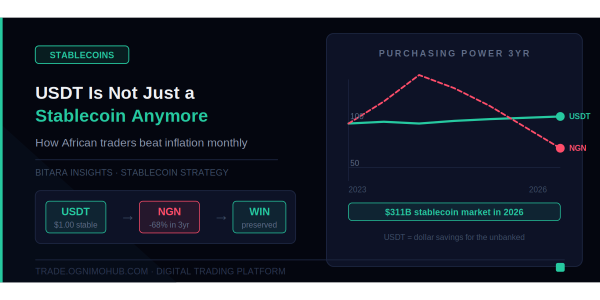
Tether's USDT — a dollar-pegged stablecoin issued on blockchain networks — has quietly become one of the most important financial instruments in the developing world. In Africa in 2026, the $311 billion stablecoin market is not primarily about trading pairs and DeFi yields. It is about the fundamental utility of holding a stable, dollar-denominated asset that does not require a bank account, a foreign exchange permit, or a relationship with a central bank.
This is why USDT is no longer just a stablecoin. It is a savings account, a payment network, and an inflation hedge — all at once.
The Numbers: What Currency Depreciation Actually Costs
To understand why USDT matters, you need to understand what holding local currency in certain African markets actually costs.
The Nigerian naira has depreciated from around NGN 360 per US dollar in 2019 to over NGN 1,400 by 2024. That is a 74% depreciation over five years — meaning a Nigerian who held savings in naira saw the purchasing power of those savings fall by three quarters in that period. Someone who converted to USDT in 2019 and held preserved their purchasing power entirely.
This is not a trading return. It is the absence of a catastrophic loss. In financial terms, avoiding a 74% loss through stablecoin savings is as valuable as generating a 74% gain.
The same dynamic plays out across the continent. Multiple African currencies have experienced significant depreciation pressure in recent years, driven by external debt servicing, commodity price shocks, and structural current account deficits. USDT addresses none of the macroeconomic causes. But for individual savers and businesses, it provides an accessible solution to the personal financial consequences.
How African Traders Are Actually Using USDT
As a Savings Vehicle
The most widespread use case is the simplest. Convert local currency to USDT through a P2P exchange or trusted counterparty. Hold USDT in a non-custodial wallet or on a licensed platform like Bitara. Access dollars without bank intermediaries. This is especially prevalent among professionals who receive income in local currency but need to preserve value in dollars.
As a Payment Rail
Stablecoins are now widely used for trade settlement, treasury management, and cross-border transactions. They offer a faster and more affordable alternative to traditional payment rails. A Ghanaian importer paying a Chinese supplier no longer needs to queue at a commercial bank for weeks waiting for dollar allocation. They send USDT directly, settlement is near-instant, and the fee is a fraction of traditional wire transfer costs.
As a Remittance Vehicle
Nigeria was Africa's largest remittance recipient in 2023, with about $19.5 billion received according to the World Bank. Traditional remittance channels charge 8–12% in fees and take 3–5 business days. USDT transfers settle in minutes at fees below 1%. The math is not complicated. A worker sending $500 home through Western Union pays $40–60 in fees. The same $500 via USDT costs less than $2.
As a Trading Base Currency
For active crypto traders on platforms like Bitara, USDT is the base from which all other positions are sized and managed. When a volatile trade closes, proceeds are held in USDT — a stable, dollar-denominated position that does not depreciate while the trader waits for the next setup. This eliminates the return leg conversion risk that exists when trading pairs are denominated in local currency.
The P2P Premium: How Traders Earn From USDT Demand
Here is the trading insight most people miss: the structural demand for USDT in African markets creates a persistent P2P premium — a spread between the official exchange rate and the rate at which USDT trades in informal markets.
In practice: if the official naira/dollar rate is 1,400, USDT may trade at 1,450–1,500 in P2P markets because the demand for accessible dollars exceeds supply. A trader who can source USDT at the official rate and sell it at the P2P premium is earning that spread as profit — without any directional crypto exposure.
This is the business model of some of the most consistent earners in the African P2P crypto ecosystem. It is not glamorous. It does not involve predicting whether BTC goes up or down. But the spread between official FX rates and P2P USDT demand is real, structural, and persistent.
On Bitara's P2P marketplace, traders can post offers at competitive spreads and earn from the liquidity premium without taking on price volatility risk.
The Risk Picture for USDT Holders
USDT is not risk-free. Understanding the risk profile is essential before making it a significant part of your financial strategy.
Tether counterparty risk: USDT's value depends on Tether Limited maintaining adequate reserves. In 2026, Tether publishes attestations showing dollar-denominated reserves backing USDT. The risk is real but has been stable for several years. Diversifying across USDT and USDC reduces concentration in any single issuer.
Smart contract risk: USDT held on-chain is subject to the security of the underlying blockchain. Using well-audited networks (Tron, Ethereum, BNB Chain) and reputable custodians (including Bitara's secure custody layer) mitigates this risk.
Regulatory risk: Governments could theoretically restrict stablecoin usage. In Africa in 2026, the regulatory trajectory is toward accommodation rather than restriction — central banks are exploring frameworks for stablecoins rather than blanket bans. But this risk exists and should be monitored.
Not a yield instrument at face value: Holding USDT in a basic wallet does not generate yield. For USDT to outperform inflation, it needs to either be deployed productively (lending, trading, P2P spreads) or simply preserve value relative to an inflating local currency — which in many African contexts it does effectively.
The Bottom Line
USDT has evolved from a crypto trading tool into a practical financial instrument for millions of people locked out of dollar banking. The $311 billion stablecoin market reflects genuine utility demand, not just speculation.
For African traders on Bitara, USDT is not just the quote currency in your trading pairs. It is a dollar savings account, a cross-border payment network, and a P2P income opportunity — all on a single platform.
Understanding this positions you ahead of the majority of market participants who still think of stablecoins as temporary parking spots between trades.
Disclaimer: This content is for informational purposes only and does not constitute financial advice.
Share This Post
By Bitara Insights · Stablecoin Strategy · May 2026 · 10 min read
The Dollar You Can Actually Hold
In Lagos, Nairobi, and Accra, asking someone at a bank to convert local currency to US dollars is not a simple transaction. In many cases, it is impossible. Foreign exchange scarcity — where central banks ration dollar access to prioritise essential imports — affects roughly 70% of African countries. For a business owner trying to pay an international supplier, or a professional trying to protect savings from a currency losing value monthly, the banking system offers no solution.
USDT does.
Tether's USDT — a dollar-pegged stablecoin issued on blockchain networks — has quietly become one of the most important financial instruments in the developing world. In Africa in 2026, the $311 billion stablecoin market is not primarily about trading pairs and DeFi yields. It is about the fundamental utility of holding a stable, dollar-denominated asset that does not require a bank account, a foreign exchange permit, or a relationship with a central bank.
This is why USDT is no longer just a stablecoin. It is a savings account, a payment network, and an inflation hedge — all at once.
The Numbers: What Currency Depreciation Actually Costs
To understand why USDT matters, you need to understand what holding local currency in certain African markets actually costs.
The Nigerian naira has depreciated from around NGN 360 per US dollar in 2019 to over NGN 1,400 by 2024. That is a 74% depreciation over five years — meaning a Nigerian who held savings in naira saw the purchasing power of those savings fall by three quarters in that period. Someone who converted to USDT in 2019 and held preserved their purchasing power entirely.
This is not a trading return. It is the absence of a catastrophic loss. In financial terms, avoiding a 74% loss through stablecoin savings is as valuable as generating a 74% gain.
The same dynamic plays out across the continent. Multiple African currencies have experienced significant depreciation pressure in recent years, driven by external debt servicing, commodity price shocks, and structural current account deficits. USDT addresses none of the macroeconomic causes. But for individual savers and businesses, it provides an accessible solution to the personal financial consequences.
How African Traders Are Actually Using USDT
As a Savings Vehicle
The most widespread use case is the simplest. Convert local currency to USDT through a P2P exchange or trusted counterparty. Hold USDT in a non-custodial wallet or on a licensed platform like Bitara. Access dollars without bank intermediaries. This is especially prevalent among professionals who receive income in local currency but need to preserve value in dollars.
As a Payment Rail
Stablecoins are now widely used for trade settlement, treasury management, and cross-border transactions. They offer a faster and more affordable alternative to traditional payment rails. A Ghanaian importer paying a Chinese supplier no longer needs to queue at a commercial bank for weeks waiting for dollar allocation. They send USDT directly, settlement is near-instant, and the fee is a fraction of traditional wire transfer costs.
As a Remittance Vehicle
Nigeria was Africa's largest remittance recipient in 2023, with about $19.5 billion received according to the World Bank. Traditional remittance channels charge 8–12% in fees and take 3–5 business days. USDT transfers settle in minutes at fees below 1%. The math is not complicated. A worker sending $500 home through Western Union pays $40–60 in fees. The same $500 via USDT costs less than $2.
As a Trading Base Currency
For active crypto traders on platforms like Bitara, USDT is the base from which all other positions are sized and managed. When a volatile trade closes, proceeds are held in USDT — a stable, dollar-denominated position that does not depreciate while the trader waits for the next setup. This eliminates the return leg conversion risk that exists when trading pairs are denominated in local currency.
The P2P Premium: How Traders Earn From USDT Demand
Here is the trading insight most people miss: the structural demand for USDT in African markets creates a persistent P2P premium — a spread between the official exchange rate and the rate at which USDT trades in informal markets.
In practice: if the official naira/dollar rate is 1,400, USDT may trade at 1,450–1,500 in P2P markets because the demand for accessible dollars exceeds supply. A trader who can source USDT at the official rate and sell it at the P2P premium is earning that spread as profit — without any directional crypto exposure.
This is the business model of some of the most consistent earners in the African P2P crypto ecosystem. It is not glamorous. It does not involve predicting whether BTC goes up or down. But the spread between official FX rates and P2P USDT demand is real, structural, and persistent.
On Bitara's P2P marketplace, traders can post offers at competitive spreads and earn from the liquidity premium without taking on price volatility risk.
The Risk Picture for USDT Holders
USDT is not risk-free. Understanding the risk profile is essential before making it a significant part of your financial strategy.
Tether counterparty risk: USDT's value depends on Tether Limited maintaining adequate reserves. In 2026, Tether publishes attestations showing dollar-denominated reserves backing USDT. The risk is real but has been stable for several years. Diversifying across USDT and USDC reduces concentration in any single issuer.
Smart contract risk: USDT held on-chain is subject to the security of the underlying blockchain. Using well-audited networks (Tron, Ethereum, BNB Chain) and reputable custodians (including Bitara's secure custody layer) mitigates this risk.
Regulatory risk: Governments could theoretically restrict stablecoin usage. In Africa in 2026, the regulatory trajectory is toward accommodation rather than restriction — central banks are exploring frameworks for stablecoins rather than blanket bans. But this risk exists and should be monitored.
Not a yield instrument at face value: Holding USDT in a basic wallet does not generate yield. For USDT to outperform inflation, it needs to either be deployed productively (lending, trading, P2P spreads) or simply preserve value relative to an inflating local currency — which in many African contexts it does effectively.
The Bottom Line
USDT has evolved from a crypto trading tool into a practical financial instrument for millions of people locked out of dollar banking. The $311 billion stablecoin market reflects genuine utility demand, not just speculation.
For African traders on Bitara, USDT is not just the quote currency in your trading pairs. It is a dollar savings account, a cross-border payment network, and a P2P income opportunity — all on a single platform.
Understanding this positions you ahead of the majority of market participants who still think of stablecoins as temporary parking spots between trades.
Disclaimer: This content is for informational purposes only and does not constitute financial advice.