The Halving Is Over. Here's Exactly What Happens to Bitcoin Price in the 18 Months After — With Charts
By Bitara Research · Bitcoin Analysis · May 2026 · 11 min read
Every Halving Has Led to a New All-Time High. Three for Three.
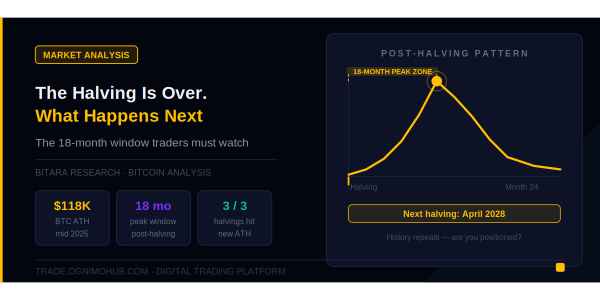
Bitcoin's fourth halving occurred in April 2024. In mid-2025, Bitcoin reached a fresh all-time high of approximately $118,000. The pattern held — again.
Three halvings. Three all-time highs in the 12–18 months following. A 100% historical hit rate.
This is either the most reliably repeating pattern in the history of financial assets, or it is a coincidence that will eventually break. Understanding which interpretation is correct — and more importantly, understanding where we are in the current cycle — is one of the most important research questions for any serious crypto trader heading into 2027.
This post gives you the data, the mechanism, and the positioning framework.
What the Halving Actually Is
Every approximately four years, the Bitcoin protocol automatically reduces the block reward paid to miners by 50%. This is called the halving. It is hard-coded into Bitcoin's software and cannot be changed.
- 2012 Halving: Block reward reduced from 50 BTC to 25 BTC
- 2016 Halving: Block reward reduced from 25 BTC to 12.5 BTC
- 2020 Halving: Block reward reduced from 12.5 BTC to 6.25 BTC
- 2024 Halving: Block reward reduced from 6.25 BTC to 3.125 BTC
The economic effect is straightforward: the rate at which new Bitcoin enters circulation drops by 50% overnight. If demand stays constant, a 50% supply reduction pushes prices higher. If demand is growing — as it has in every halving cycle — the price effect is amplified.
The Historical Pattern: Three Data Points
2012 Halving (November)
Bitcoin was trading around $12 at the time of the halving. By November 2013 — approximately 12 months later — it reached $1,100. That is a roughly 9,000% return in 12 months.
2016 Halving (July)
Bitcoin was trading around $650. By December 2017 — approximately 17 months later — it reached $19,800. That is a roughly 2,950% return in 17 months.
2020 Halving (May)
Bitcoin was trading around $8,700. By November 2021 — approximately 18 months later — it reached $69,000. That is a roughly 693% return in 18 months.
2024 Halving (April)
Bitcoin was trading around $63,000. By mid-2025 — approximately 14 months later — it reached approximately $118,000. That is roughly an 87% return from the halving price.
Why the Returns Are Diminishing — And What It Means
The observant reader will notice: the percentage returns from each halving are getting smaller. 9,000% → 2,950% → 693% → 87%. This is mathematically inevitable as Bitcoin's market cap grows. A $12 asset moving to $1,100 is different from a $63,000 asset moving to $118,000 in absolute dollar terms — the latter represents a far larger increase in total market value.
This matters for positioning. The 2024/2025 cycle did not produce the percentage returns of 2020/2021. It produced a new all-time high on a much larger base, with institutional participation that was not present in previous cycles, and with a price floor supported by Bitcoin ETF demand from institutional allocators including BlackRock, Fidelity, and Invesco.
The correct framework for 2026/2027 is not "BTC will do 693% from the halving price." It is: what is the realistic upside given the current base and the catalysts in the current cycle?
The 18-Month Window: Where Are We Now?
The historical peak window falls between 12 and 18 months after the halving. The 2024 halving occurred in April 2024. The 18-month peak window therefore runs from April 2025 to October 2025.
Bitcoin's mid-2025 ATH of approximately $118,000 is consistent with this window. The question heading into 2026 and 2027 is whether the cycle has completed its peak, is in a mid-cycle correction before a higher high, or is in a prolonged distribution phase.
Two institutional tailwinds that did not exist in previous cycles support a more extended or elevated price structure:
Spot Bitcoin ETF demand: The approval of spot Bitcoin ETFs in the United States created a persistent institutional buying channel. When Blackrock's IBIT ETF sees $500 million in daily inflows, that demand is not price-sensitive in the way retail demand is. It flows regardless of short-term price action, creating a structural support floor.
Corporate treasury adoption: Following MicroStrategy's playbook, a growing number of public companies adopted Bitcoin as a treasury reserve asset in 2024 and 2025. Corporate treasury Bitcoin represents long-duration demand that does not respond to monthly volatility.
Key Levels and the 2027 Thesis
The next Bitcoin halving is scheduled for approximately April 2028. If historical patterns hold — and there are structural reasons to expect them to, given the mathematical supply reduction and growing institutional demand — the window between now and Q1 2028 represents the post-peak distribution and accumulation phase before the next cycle begins.
For traders, this creates specific strategic considerations:
Spot accumulation on dips during the post-peak consolidation is how historically successful Bitcoin strategies are built. The cycle that plays out between mid-2026 and Q1 2028 is likely to be a period of range trading with significant volatility — not the straight-line appreciation of a bull cycle peak, but not the absolute bear market of 2022 either.
Futures positioning during this phase should focus on tactical range trades rather than sustained directional leverage. The historical pattern shows Bitcoin spends the 12–18 months before the next halving in a wide trading range, offering multiple entry and exit opportunities for disciplined traders.
Altcoin cycle awareness: Historically, the period 6–18 months after Bitcoin's ATH has been the period of maximum altcoin outperformance — as capital rotates from Bitcoin into higher-beta assets. The AI, RWA, and DePIN narratives covered in Post 1 of this series are the likely vessels for that rotation in 2026–2027.
The Risk That Breaks the Pattern
The halving cycle framework is a historical pattern, not a law. The scenario that breaks it is straightforward: a macroeconomic shock — a financial crisis, a sovereign debt event, a major geopolitical escalation — that triggers broad-based deleveraging across all risk assets simultaneously.
In that scenario, Bitcoin's correlation to broader risk markets, which has been elevated in 2025–2026 as institutional participation has grown, means it would likely fall alongside equities and other risk assets regardless of where it is in its halving cycle.
Professional traders position for the base case (pattern continues) while respecting the tail risk (pattern breaks). That means appropriate position sizing, defined stop levels, and avoiding over-leveraged exposure to a thesis however historically well-supported.
Share This Post
By Bitara Research · Bitcoin Analysis · May 2026 · 11 min read
Every Halving Has Led to a New All-Time High. Three for Three.
Bitcoin's fourth halving occurred in April 2024. In mid-2025, Bitcoin reached a fresh all-time high of approximately $118,000. The pattern held — again.
Three halvings. Three all-time highs in the 12–18 months following. A 100% historical hit rate.
This is either the most reliably repeating pattern in the history of financial assets, or it is a coincidence that will eventually break. Understanding which interpretation is correct — and more importantly, understanding where we are in the current cycle — is one of the most important research questions for any serious crypto trader heading into 2027.
This post gives you the data, the mechanism, and the positioning framework.
What the Halving Actually Is
Every approximately four years, the Bitcoin protocol automatically reduces the block reward paid to miners by 50%. This is called the halving. It is hard-coded into Bitcoin's software and cannot be changed.
- 2012 Halving: Block reward reduced from 50 BTC to 25 BTC
- 2016 Halving: Block reward reduced from 25 BTC to 12.5 BTC
- 2020 Halving: Block reward reduced from 12.5 BTC to 6.25 BTC
- 2024 Halving: Block reward reduced from 6.25 BTC to 3.125 BTC
The economic effect is straightforward: the rate at which new Bitcoin enters circulation drops by 50% overnight. If demand stays constant, a 50% supply reduction pushes prices higher. If demand is growing — as it has in every halving cycle — the price effect is amplified.
The Historical Pattern: Three Data Points
2012 Halving (November)
Bitcoin was trading around $12 at the time of the halving. By November 2013 — approximately 12 months later — it reached $1,100. That is a roughly 9,000% return in 12 months.
2016 Halving (July)
Bitcoin was trading around $650. By December 2017 — approximately 17 months later — it reached $19,800. That is a roughly 2,950% return in 17 months.
2020 Halving (May)
Bitcoin was trading around $8,700. By November 2021 — approximately 18 months later — it reached $69,000. That is a roughly 693% return in 18 months.
2024 Halving (April)
Bitcoin was trading around $63,000. By mid-2025 — approximately 14 months later — it reached approximately $118,000. That is roughly an 87% return from the halving price.
Why the Returns Are Diminishing — And What It Means
The observant reader will notice: the percentage returns from each halving are getting smaller. 9,000% → 2,950% → 693% → 87%. This is mathematically inevitable as Bitcoin's market cap grows. A $12 asset moving to $1,100 is different from a $63,000 asset moving to $118,000 in absolute dollar terms — the latter represents a far larger increase in total market value.
This matters for positioning. The 2024/2025 cycle did not produce the percentage returns of 2020/2021. It produced a new all-time high on a much larger base, with institutional participation that was not present in previous cycles, and with a price floor supported by Bitcoin ETF demand from institutional allocators including BlackRock, Fidelity, and Invesco.
The correct framework for 2026/2027 is not "BTC will do 693% from the halving price." It is: what is the realistic upside given the current base and the catalysts in the current cycle?
The 18-Month Window: Where Are We Now?
The historical peak window falls between 12 and 18 months after the halving. The 2024 halving occurred in April 2024. The 18-month peak window therefore runs from April 2025 to October 2025.
Bitcoin's mid-2025 ATH of approximately $118,000 is consistent with this window. The question heading into 2026 and 2027 is whether the cycle has completed its peak, is in a mid-cycle correction before a higher high, or is in a prolonged distribution phase.
Two institutional tailwinds that did not exist in previous cycles support a more extended or elevated price structure:
Spot Bitcoin ETF demand: The approval of spot Bitcoin ETFs in the United States created a persistent institutional buying channel. When Blackrock's IBIT ETF sees $500 million in daily inflows, that demand is not price-sensitive in the way retail demand is. It flows regardless of short-term price action, creating a structural support floor.
Corporate treasury adoption: Following MicroStrategy's playbook, a growing number of public companies adopted Bitcoin as a treasury reserve asset in 2024 and 2025. Corporate treasury Bitcoin represents long-duration demand that does not respond to monthly volatility.
Key Levels and the 2027 Thesis
The next Bitcoin halving is scheduled for approximately April 2028. If historical patterns hold — and there are structural reasons to expect them to, given the mathematical supply reduction and growing institutional demand — the window between now and Q1 2028 represents the post-peak distribution and accumulation phase before the next cycle begins.
For traders, this creates specific strategic considerations:
Spot accumulation on dips during the post-peak consolidation is how historically successful Bitcoin strategies are built. The cycle that plays out between mid-2026 and Q1 2028 is likely to be a period of range trading with significant volatility — not the straight-line appreciation of a bull cycle peak, but not the absolute bear market of 2022 either.
Futures positioning during this phase should focus on tactical range trades rather than sustained directional leverage. The historical pattern shows Bitcoin spends the 12–18 months before the next halving in a wide trading range, offering multiple entry and exit opportunities for disciplined traders.
Altcoin cycle awareness: Historically, the period 6–18 months after Bitcoin's ATH has been the period of maximum altcoin outperformance — as capital rotates from Bitcoin into higher-beta assets. The AI, RWA, and DePIN narratives covered in Post 1 of this series are the likely vessels for that rotation in 2026–2027.
The Risk That Breaks the Pattern
The halving cycle framework is a historical pattern, not a law. The scenario that breaks it is straightforward: a macroeconomic shock — a financial crisis, a sovereign debt event, a major geopolitical escalation — that triggers broad-based deleveraging across all risk assets simultaneously.
In that scenario, Bitcoin's correlation to broader risk markets, which has been elevated in 2025–2026 as institutional participation has grown, means it would likely fall alongside equities and other risk assets regardless of where it is in its halving cycle.
Professional traders position for the base case (pattern continues) while respecting the tail risk (pattern breaks). That means appropriate position sizing, defined stop levels, and avoiding over-leveraged exposure to a thesis however historically well-supported.