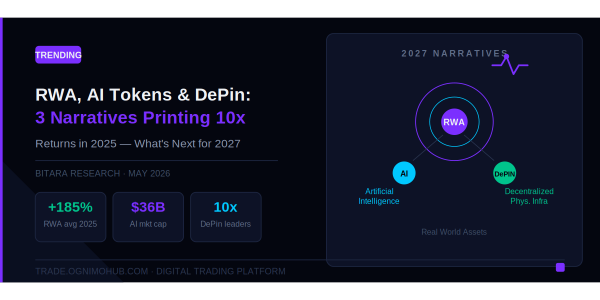
RWA, AI Tokens & DePin: The 3 Narratives Quietly Printing 10x Returns — And What's Next for 2027
By Bitara Research Desk · May 2026 · 12 min read
The Market Has Already Moved. Most Traders Missed It.
While Bitcoin's headline-grabbing run to $118,000 dominated crypto news in mid-2025, a quieter revolution was happening in three sectors most retail traders barely noticed. Real World Assets (RWA), AI tokens, and Decentralized Physical Infrastructure Networks (DePIN) were compounding silently — and by the time the mainstream caught on, the first wave of 10x returns had already printed.
This is not a prediction post. This is a forensic breakdown of what happened, why it happened, and more importantly — where the next leg of this trade is heading into 2027. If you are a Bitara trader looking to position yourself with real conviction rather than chasing hype, read every word.
Part 1: RWA — The Sleeping Giant That Woke Up
What Just Happened
Real World Asset tokenization — the process of representing traditional financial instruments like bonds, real estate, commodities, and private credit as blockchain tokens — was largely dismissed as "institutional experimentation" as recently as 2024. In the first half of 2025, the market cap of tokenized RWAs (excluding stablecoins) jumped from approximately $8.6 billion to over $23 billion. That is a 260% move in six months.
By early 2026, on-chain tokenized RWAs sat between $19 billion and $36 billion depending on methodology, with projections pointing toward $100 billion by year-end 2026. The sector saw roughly 66% growth in 2026 alone, fuelled by tokenized US Treasuries, private credit, and an avalanche of institutional capital.
The tipping point was regulatory. The passage of the GENIUS Act in July 2025 established a federal framework for payment stablecoins and provided standardised settlement infrastructure. This was not the only change — updated compliance thresholds, progressive market structure legislation, and on-chain capital market mandates collectively gave institutions the legal clarity they had been waiting for. The result was a surge of capital that dwarfed every previous RWA cycle.
Who Is Driving It
This is not retail-driven speculation. BlackRock's tokenized Treasury fund (BUIDL) became the flagship product in the category. JPMorgan is building blockchain-native payments and investment instruments on Ethereum. Goldman Sachs and BNY Mellon are experimenting with tokenized money market funds. Ethereum now accounts for approximately 34% of total on-chain RWA value across all networks, with stablecoins on Ethereum mainnet climbing above $175 billion in aggregate market capitalisation.
The data from Chainalysis tells an even more interesting story: after years of flat activity from 2022 to late 2024, the number of new Ethereum wallets created specifically to hold tokenised assets exploded in an "explosive growth curve sharply accelerating into 2026." For this new cohort, RWAs are the reason to come on-chain — not DeFi, not NFTs, not memecoins.
What to Watch Into 2027
The distributed RWA market — tokenized assets freely transferable on-chain — is projected to grow from roughly $29 billion today to $400 billion by 2030, according to a joint report from market maker Keyrock and tokenisation platform Securitize. More conservatively, McKinsey projects $2–4 trillion in tokenised financial assets by 2030. BCG estimates $16 trillion.
The divergence in forecasts is not because analysts disagree on direction. They all agree it is going up massively. The divergence is in how broadly you define the addressable market — and today's on-chain tokenised RWAs represent less than 0.1% of the $400 trillion global asset base eligible for tokenisation.
Key tokens to understand: ONDO (Ondo Finance, tokenised Treasuries), PAXG/XAUT (tokenised gold), PENDLE (yield tokenisation). Note that RWA perps — perpetual futures tied to gold, silver, and oil — grew 40x in six months on-chain, making them the fastest-growing channel for RWA exposure.
The 2027 catalyst: Tokenised equities and tokenised ETFs are the next frontier. 2026 is the year of Treasuries and private credit. 2027 is the year equity markets go on-chain at scale.
Part 2: AI Tokens — Infrastructure Over Narrative
What Just Happened
The 2024 AI token mania produced spectacular returns followed by spectacular crashes. The lesson the market learned: pure narrative tokens die, infrastructure tokens survive and compound.
By Q1 2026, the picture is clear. Projects with real on-chain activity and defensible use cases held or recovered their ground. Pure narrative tokens — anything that simply added "AI" to a whitepaper — struggled. The divergence is now obvious to anyone paying attention.
Bittensor (TAO) leads the category at a $3.4 billion market cap. Following its halving in December 2025 — which reduced daily emissions from 7,200 to 3,600 TAO, mirroring Bitcoin's scarcity model — the network transitioned from an inflationary growth phase to a utility-driven model. The network now supports 128 specialised subnets, each a marketplace for specific AI tasks from language models to image generation to serverless compute. Analysts suggest that if TAO continues capturing market share from centralised AI labs, it could challenge the top 5 assets by market capitalisation.
Render Network (RNDR) added AI inference functionality and multi-chain support in 2025. NVIDIA's GTC keynote in March 2026, which projected $1 trillion in chip demand through 2027, sent AI tokens higher across the board — including RNDR, which operates as a decentralised GPU rendering and compute network. The platform has now successfully onboarded NVIDIA's Blackwell B200 architecture, offering enterprise-grade compute at scale.
NEAR Protocol is leading the "User-Owned AI" movement, ensuring data privacy through hardware-secured enclaves. The Artificial Superintelligence Alliance (FET) continues to build autonomous economic agents across supply chains, smart cities, and machine negotiations.
The DePIN Convergence
Here is the insight most traders are missing: DePIN and AI tokens are no longer separate categories. They have merged.
Most major DePIN projects — Render, io.net, Grass — are now primarily serving AI workloads. Grass, a DePIN data network that pays users to contribute unused internet bandwidth for AI training data scraping, rallied 28% in 24 hours in mid-March 2026 when Nvidia's GTC keynote gained mainstream attention. The network is supported by over 2.5 million user devices globally and operates nearly one million active nodes.
Akash Network (AKT), described as the "decentralised AWS for AI," allows anyone to deploy apps or inference engines across a distributed GPU marketplace. Enterprise cloud buyers are tapping these networks for compute overflow capacity and edge computing. As of September 2025, the DePIN sector had a combined market cap above $19 billion, up from just $5.2 billion a year prior.
Part 3: DePIN — When Crypto Goes Physical
What Just Happened
DePIN uses token incentives to mobilise communities rather than corporations to build critical physical infrastructure — wireless networks, sensor grids, GPU compute marketplaces, bandwidth networks, energy grids. By September 2025, CoinGecko was tracking nearly 250 DePIN projects with a combined market cap above $19 billion.
This is no longer theoretical. Enterprise cloud buyers are routing real AI compute workloads through these networks. Networks like Akash and io.net are generating actual revenue — not just token speculation — as miners shift from token incentives to real service fees. The $35 billion DePIN sector valuation, with 412 active projects deployed globally, represents hardware and bandwidth already deployed in the real world.
The Thesis for 2027
By 2026, the breakout consumer applications in this space are not marketing themselves as "crypto." They feel like modern fintech, with AI agents, stablecoin settlement, and provenance running quietly under the hood. This is the next phase of DePIN: invisible infrastructure powering everyday applications.
The convergence to watch is AI + DePIN + RWA. As AI models require larger training sets, DePIN networks provide the decentralised data pipelines. As those models generate yield-bearing outputs, RWA frameworks provide the on-chain financial infrastructure to monetise them. These three narratives are not separate bets — they are a single, compounding thesis about what the internet looks like in 2027 and beyond.
How to Position on Bitara
Understanding the narrative is one thing. Trading it is another. Here is how traders are approaching these sectors on platforms like Bitara:
Spot trading remains the cleanest entry for RWA tokens like ONDO, PAXG, and larger-cap AI tokens like TAO and FET. You own the asset directly with no liquidation risk.
Futures trading allows directional exposure with leverage on the more established tokens in these categories. Given the volatility — especially in AI tokens where 50–90% drawdowns from peaks are common — position sizing and stop placement are non-negotiable. The 10x leverage narrative cuts both ways.
Copy trading offers a way to follow traders who specialise in these narratives without needing to monitor positions 24/7. On a platform like Bitara, identifying a lead trader with a verified track record in AI/DePIN tokens can provide diversified exposure across the sector.
Binary options can be used to take short-term views on catalyst events — token halvings, protocol upgrades, major partnership announcements — without the unlimited downside risk of unhedged futures.
The Risk Picture — Because This Is a Professional Platform
None of this is without risk. The AI crypto sector lost an estimated $35 billion in 2025 through scams, rug pulls, and project failures. Massive token unlock schedules, direct competition from the world's most well-funded tech companies (Google, Microsoft, OpenAI), and regulatory uncertainty around biometric data collection and AI agent activity all represent real tail risks.
For RWA specifically: most tokenised RWA tokens suffer low liquidity, long holding periods, and limited secondary trading. Regulatory gating, valuation opacity, and custodial concentration remain structural frictions that will take time to resolve.
The disciplined approach: sector exposure through multiple assets rather than concentrated single-token bets. Stablecoin entry points during drawdowns rather than FOMO chasing. Clear exit levels defined before entry.
The Bottom Line
The three narratives — RWA, AI tokens, and DePIN — are not independent trends running in parallel. They are converging into a single thesis about the next phase of crypto adoption: one where blockchain becomes invisible infrastructure for traditional finance, artificial intelligence, and physical-world services simultaneously.
The traders who positioned in 2024 and early 2025 captured the first wave. The traders who understand the thesis deeply enough to hold through volatility — and to size correctly — will capture the second wave, which analysts broadly expect to play out through 2027 as the post-halving bull cycle peaks, tokenised equity markets come online, and AI agents begin transacting autonomously at scale.
The opportunity is real. The data backs it. The execution is yours.
Disclaimer: This content is for informational and educational purposes only. Nothing in this article constitutes financial advice. Crypto markets are highly volatile. Always conduct your own research and trade only what you can afford to lose. Past performance does not guarantee future results.
Share This Post
By Bitara Research Desk · May 2026 · 12 min read
The Market Has Already Moved. Most Traders Missed It.
While Bitcoin's headline-grabbing run to $118,000 dominated crypto news in mid-2025, a quieter revolution was happening in three sectors most retail traders barely noticed. Real World Assets (RWA), AI tokens, and Decentralized Physical Infrastructure Networks (DePIN) were compounding silently — and by the time the mainstream caught on, the first wave of 10x returns had already printed.
This is not a prediction post. This is a forensic breakdown of what happened, why it happened, and more importantly — where the next leg of this trade is heading into 2027. If you are a Bitara trader looking to position yourself with real conviction rather than chasing hype, read every word.
Part 1: RWA — The Sleeping Giant That Woke Up
What Just Happened
Real World Asset tokenization — the process of representing traditional financial instruments like bonds, real estate, commodities, and private credit as blockchain tokens — was largely dismissed as "institutional experimentation" as recently as 2024. In the first half of 2025, the market cap of tokenized RWAs (excluding stablecoins) jumped from approximately $8.6 billion to over $23 billion. That is a 260% move in six months.
By early 2026, on-chain tokenized RWAs sat between $19 billion and $36 billion depending on methodology, with projections pointing toward $100 billion by year-end 2026. The sector saw roughly 66% growth in 2026 alone, fuelled by tokenized US Treasuries, private credit, and an avalanche of institutional capital.
The tipping point was regulatory. The passage of the GENIUS Act in July 2025 established a federal framework for payment stablecoins and provided standardised settlement infrastructure. This was not the only change — updated compliance thresholds, progressive market structure legislation, and on-chain capital market mandates collectively gave institutions the legal clarity they had been waiting for. The result was a surge of capital that dwarfed every previous RWA cycle.
Who Is Driving It
This is not retail-driven speculation. BlackRock's tokenized Treasury fund (BUIDL) became the flagship product in the category. JPMorgan is building blockchain-native payments and investment instruments on Ethereum. Goldman Sachs and BNY Mellon are experimenting with tokenized money market funds. Ethereum now accounts for approximately 34% of total on-chain RWA value across all networks, with stablecoins on Ethereum mainnet climbing above $175 billion in aggregate market capitalisation.
The data from Chainalysis tells an even more interesting story: after years of flat activity from 2022 to late 2024, the number of new Ethereum wallets created specifically to hold tokenised assets exploded in an "explosive growth curve sharply accelerating into 2026." For this new cohort, RWAs are the reason to come on-chain — not DeFi, not NFTs, not memecoins.
What to Watch Into 2027
The distributed RWA market — tokenized assets freely transferable on-chain — is projected to grow from roughly $29 billion today to $400 billion by 2030, according to a joint report from market maker Keyrock and tokenisation platform Securitize. More conservatively, McKinsey projects $2–4 trillion in tokenised financial assets by 2030. BCG estimates $16 trillion.
The divergence in forecasts is not because analysts disagree on direction. They all agree it is going up massively. The divergence is in how broadly you define the addressable market — and today's on-chain tokenised RWAs represent less than 0.1% of the $400 trillion global asset base eligible for tokenisation.
Key tokens to understand: ONDO (Ondo Finance, tokenised Treasuries), PAXG/XAUT (tokenised gold), PENDLE (yield tokenisation). Note that RWA perps — perpetual futures tied to gold, silver, and oil — grew 40x in six months on-chain, making them the fastest-growing channel for RWA exposure.
The 2027 catalyst: Tokenised equities and tokenised ETFs are the next frontier. 2026 is the year of Treasuries and private credit. 2027 is the year equity markets go on-chain at scale.
Part 2: AI Tokens — Infrastructure Over Narrative
What Just Happened
The 2024 AI token mania produced spectacular returns followed by spectacular crashes. The lesson the market learned: pure narrative tokens die, infrastructure tokens survive and compound.
By Q1 2026, the picture is clear. Projects with real on-chain activity and defensible use cases held or recovered their ground. Pure narrative tokens — anything that simply added "AI" to a whitepaper — struggled. The divergence is now obvious to anyone paying attention.
Bittensor (TAO) leads the category at a $3.4 billion market cap. Following its halving in December 2025 — which reduced daily emissions from 7,200 to 3,600 TAO, mirroring Bitcoin's scarcity model — the network transitioned from an inflationary growth phase to a utility-driven model. The network now supports 128 specialised subnets, each a marketplace for specific AI tasks from language models to image generation to serverless compute. Analysts suggest that if TAO continues capturing market share from centralised AI labs, it could challenge the top 5 assets by market capitalisation.
Render Network (RNDR) added AI inference functionality and multi-chain support in 2025. NVIDIA's GTC keynote in March 2026, which projected $1 trillion in chip demand through 2027, sent AI tokens higher across the board — including RNDR, which operates as a decentralised GPU rendering and compute network. The platform has now successfully onboarded NVIDIA's Blackwell B200 architecture, offering enterprise-grade compute at scale.
NEAR Protocol is leading the "User-Owned AI" movement, ensuring data privacy through hardware-secured enclaves. The Artificial Superintelligence Alliance (FET) continues to build autonomous economic agents across supply chains, smart cities, and machine negotiations.
The DePIN Convergence
Here is the insight most traders are missing: DePIN and AI tokens are no longer separate categories. They have merged.
Most major DePIN projects — Render, io.net, Grass — are now primarily serving AI workloads. Grass, a DePIN data network that pays users to contribute unused internet bandwidth for AI training data scraping, rallied 28% in 24 hours in mid-March 2026 when Nvidia's GTC keynote gained mainstream attention. The network is supported by over 2.5 million user devices globally and operates nearly one million active nodes.
Akash Network (AKT), described as the "decentralised AWS for AI," allows anyone to deploy apps or inference engines across a distributed GPU marketplace. Enterprise cloud buyers are tapping these networks for compute overflow capacity and edge computing. As of September 2025, the DePIN sector had a combined market cap above $19 billion, up from just $5.2 billion a year prior.
Part 3: DePIN — When Crypto Goes Physical
What Just Happened
DePIN uses token incentives to mobilise communities rather than corporations to build critical physical infrastructure — wireless networks, sensor grids, GPU compute marketplaces, bandwidth networks, energy grids. By September 2025, CoinGecko was tracking nearly 250 DePIN projects with a combined market cap above $19 billion.
This is no longer theoretical. Enterprise cloud buyers are routing real AI compute workloads through these networks. Networks like Akash and io.net are generating actual revenue — not just token speculation — as miners shift from token incentives to real service fees. The $35 billion DePIN sector valuation, with 412 active projects deployed globally, represents hardware and bandwidth already deployed in the real world.
The Thesis for 2027
By 2026, the breakout consumer applications in this space are not marketing themselves as "crypto." They feel like modern fintech, with AI agents, stablecoin settlement, and provenance running quietly under the hood. This is the next phase of DePIN: invisible infrastructure powering everyday applications.
The convergence to watch is AI + DePIN + RWA. As AI models require larger training sets, DePIN networks provide the decentralised data pipelines. As those models generate yield-bearing outputs, RWA frameworks provide the on-chain financial infrastructure to monetise them. These three narratives are not separate bets — they are a single, compounding thesis about what the internet looks like in 2027 and beyond.
How to Position on Bitara
Understanding the narrative is one thing. Trading it is another. Here is how traders are approaching these sectors on platforms like Bitara:
Spot trading remains the cleanest entry for RWA tokens like ONDO, PAXG, and larger-cap AI tokens like TAO and FET. You own the asset directly with no liquidation risk.
Futures trading allows directional exposure with leverage on the more established tokens in these categories. Given the volatility — especially in AI tokens where 50–90% drawdowns from peaks are common — position sizing and stop placement are non-negotiable. The 10x leverage narrative cuts both ways.
Copy trading offers a way to follow traders who specialise in these narratives without needing to monitor positions 24/7. On a platform like Bitara, identifying a lead trader with a verified track record in AI/DePIN tokens can provide diversified exposure across the sector.
Binary options can be used to take short-term views on catalyst events — token halvings, protocol upgrades, major partnership announcements — without the unlimited downside risk of unhedged futures.
The Risk Picture — Because This Is a Professional Platform
None of this is without risk. The AI crypto sector lost an estimated $35 billion in 2025 through scams, rug pulls, and project failures. Massive token unlock schedules, direct competition from the world's most well-funded tech companies (Google, Microsoft, OpenAI), and regulatory uncertainty around biometric data collection and AI agent activity all represent real tail risks.
For RWA specifically: most tokenised RWA tokens suffer low liquidity, long holding periods, and limited secondary trading. Regulatory gating, valuation opacity, and custodial concentration remain structural frictions that will take time to resolve.
The disciplined approach: sector exposure through multiple assets rather than concentrated single-token bets. Stablecoin entry points during drawdowns rather than FOMO chasing. Clear exit levels defined before entry.
The Bottom Line
The three narratives — RWA, AI tokens, and DePIN — are not independent trends running in parallel. They are converging into a single thesis about the next phase of crypto adoption: one where blockchain becomes invisible infrastructure for traditional finance, artificial intelligence, and physical-world services simultaneously.
The traders who positioned in 2024 and early 2025 captured the first wave. The traders who understand the thesis deeply enough to hold through volatility — and to size correctly — will capture the second wave, which analysts broadly expect to play out through 2027 as the post-halving bull cycle peaks, tokenised equity markets come online, and AI agents begin transacting autonomously at scale.
The opportunity is real. The data backs it. The execution is yours.
Disclaimer: This content is for informational and educational purposes only. Nothing in this article constitutes financial advice. Crypto markets are highly volatile. Always conduct your own research and trade only what you can afford to lose. Past performance does not guarantee future results.