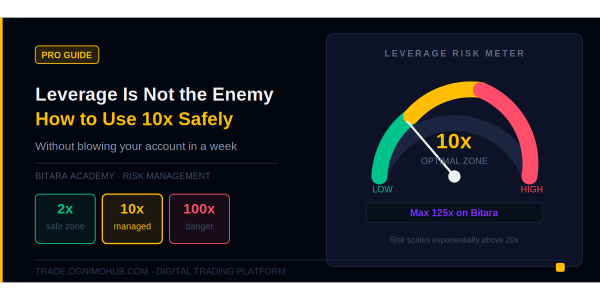
Leverage Is Not the Enemy: How to Use 10x Without Blowing Your Account in a Week
By Bitara Academy · May 2026 · 11 min read
The Myth That Kills New Traders Before They Start
Most people approach crypto leverage in one of two ways. Either they avoid it entirely, convinced it is a gambling mechanism for reckless gamblers — and miss some of the most capital-efficient trades available. Or they dive in, crank the slider to 50x because the number looks exciting, and are liquidated within days.
Both approaches are wrong. Both stem from the same misunderstanding: that leverage is the variable that determines your outcome.
It is not. Risk management is the variable that determines your outcome. Leverage is just the tool.
In 2026, futures trading represents approximately 77% of total crypto trading volume — dwarfing spot markets 3.4 to 1. The professional traders, the prop firms, the institutional desks — they all use leverage. The question is not whether to use it. The question is how to use it without becoming one of the 182,000 traders who were liquidated in a single 24-hour window on January 20, 2026, when over $1.08 billion was forcibly closed in one day.
This post teaches you the difference.
What Leverage Actually Is
Leverage is borrowing. When you trade at 10x leverage, you deposit $100 (your margin) and the exchange lends you $900, giving you control of a $1,000 position. Your profit and loss are calculated on the full $1,000, not on your $100 deposit.
The maths:
- $1,000 position at 10x leverage with $100 margin
- BTC moves up 5% → you profit $50 → that is a 50% return on your $100 margin
- BTC moves down 5% → you lose $50 → that is a 50% loss on your $100 margin
- BTC moves down 10% → your $100 margin is gone → liquidation
At 10x leverage, a 10% adverse move liquidates you. At 50x, a 2% adverse move does it. At 100x, less than 1%.
This is why leverage choice is inseparable from stop-loss placement and position sizing. The leverage multiplier alone tells you nothing useful. What matters is how you size the position relative to your account and where you place your stop.
The Number That Actually Matters: Liquidation Price
Before entering any leveraged trade, you need to know one number: your liquidation price.
The formula for a long position:
Liquidation Price = Entry Price × (1 - (Margin Allocated - Maintenance Margin) ÷ Position Size)
Most platforms calculate this for you. But you need to understand it, not just read it. If your liquidation price is 8% below your entry on a 10x position, and Bitcoin routinely moves 5–10% in a single day in 2026's macro environment, you are one bad session away from a zero.
The fix is not to use less leverage. The fix is to use a stop-loss placed at a technically meaningful level before your liquidation price — so the trade closes at your chosen loss threshold rather than at forced liquidation.
The 1–2% Rule: The Single Most Important Concept in Leveraged Trading
Professional traders follow this rule without exception: never risk more than 1–2% of total capital on a single trade.
This does not mean limit your position size to 1–2% of capital. It means calibrate your position size and leverage so that if the trade hits your pre-set stop-loss, the total loss stays within that threshold.
Example:
- Account size: $5,000
- Risk per trade (1% rule): $50 maximum loss
- You want to trade BTC at $67,000
- Stop-loss: $66,000 (about 1.5% below entry)
- Position size calculation: $50 ÷ 0.015 = $3,333 notional position
- Required margin at 10x leverage: $333
You control a $3,333 position with $333 margin. If BTC hits your stop at $66,000, you lose $50 — exactly 1% of your $5,000 account. The trade closes. You live to trade again.
Why this matters over the long run:
A trader following the 1% rule can lose 20 consecutive trades and still retain over 80% of their capital. A trader risking 10% per trade is effectively insolvent after 10 losses. In volatile crypto markets where well-researched setups regularly fail, surviving a losing streak is the most important factor in long-term profitability.
Choosing the Right Leverage Level
The question is never "what is the maximum leverage available?" The question is "what is the right leverage for this trade, this volatility, this stop-loss distance?"
2x — The Foundation Level
Appropriate for: longer-term directional trades (days to weeks), wide stops, high volatility assets, new traders learning position mechanics. At 2x, a 50% adverse move liquidates you — essentially only possible through exchange failure or an absolute black swan.
5–10x — The Professional Sweet Spot
Appropriate for: swing trades with clear structure, well-defined support/resistance stops, assets with moderate daily volatility. Many professional traders rarely exceed 10x leverage even with years of experience. The 10x range allows meaningful capital efficiency without the hair-trigger liquidation risk of higher multipliers.
20–50x — Advanced Tactical Positions
Appropriate for: short-duration scalps with extremely tight stops, professional traders with deep understanding of funding rates and mark price mechanics, highly liquid assets (BTC, ETH). At these levels, even normal daily volatility can be a liquidation event if stops are not precisely placed.
100x+ — Almost Never Appropriate
This leverage level is available on Bitara for institutional users and experienced traders who understand exactly what they are doing. For the vast majority of traders, it is a guaranteed path to liquidation. A 1% adverse move on a 100x position eliminates your entire margin.
Isolated vs. Cross Margin: Choose Deliberately
This choice is more important than most traders realise.
Isolated Margin: Your risk is restricted to the margin allocated to a specific position. If that trade goes to zero, only that position's margin is lost — not your entire account. This is the correct choice for most trades.
Cross Margin: Your entire account balance serves as collateral for all positions. This prevents liquidation in minor price dips by giving positions more room. But a large move that affects multiple positions simultaneously can drain your entire account. Use this mode only when you fully understand the implications.
The default recommendation: use isolated margin, always, until you have significant experience and a specific strategic reason to switch.
Funding Rates: The Silent Account Killer
Perpetual futures contracts charge a "funding rate" — a periodic payment between long and short traders that keeps futures prices aligned with spot prices. In bull markets, longs pay shorts. In bear markets, shorts pay longs.
In a sustained bull cycle, Bitcoin perpetuals funding rates run +0.01% to +0.05% every 8 hours. At +0.015% × 3 intervals per day, that is 0.045% daily funding drag — approximately 16% annualised — on any leveraged long position held continuously.
This means: even if your trade is directionally correct and BTC is slowly rising, funding rate drag can eat your profits if you hold leveraged positions for extended periods. Professional traders account for funding rate costs in their position thesis. Amateurs ignore it until they wonder why a winning position is actually losing money.
Before opening any leveraged position: check the current funding rate on Bitara. If it is elevated (above 0.05% per 8 hours), factor this cost into your expected return and consider whether the trade still makes sense at that cost.
The Pre-Trade Checklist
Before entering any leveraged position on Bitara, run through these six questions:
- What is my liquidation price? (Calculate it. Write it down.)
- Where is my stop-loss? (Set it before entering. Not after.)
- What is my maximum dollar loss if stop hits? (Must be ≤1–2% of account.)
- What is the current funding rate? (Is this position being held through multiple funding periods?)
- Am I using isolated margin? (Default to yes unless you have a specific reason otherwise.)
- What is my take-profit target? (Define your exit before entering. Both directions.)
If you cannot answer all six, do not enter the trade. This is not bureaucracy. This is the difference between professional trading and gambling.
Leverage vs. Spot: When to Use Which
Not every trade requires leverage. The most effective traders use spot for certain situations and futures/leverage for others.
Use spot when:
- You are taking a long-term position (weeks to months) in an asset you believe in
- Volatility makes precise stop placement difficult
- You want to earn staking or yield on the underlying asset
- You are new to a market and still building conviction
Use leverage when:
- You have a well-defined short-term setup with clear entry, stop, and target
- You want to short — you cannot profit from falling prices in spot markets
- You want to hedge your spot holdings during uncertain periods
- Capital efficiency matters and you have a proven risk management process
Common Leverage Mistakes That Wipe Accounts
Averaging into losing leveraged positions. If a trade is going against you, adding to the position increases your exposure and moves your liquidation price closer. This is how accounts blow up spectacularly. Exit the losing trade. Re-evaluate. Re-enter only if the thesis is still valid.
Trading maximum position size. The platform allows 125x. This does not mean you should use 125x. The availability of a leverage level is not an endorsement of its use.
Not using stop-losses. "I'll watch it" is not a risk management strategy. Markets move fast. You will not always be watching. Set your stop before you enter.
Using cross margin with multiple leveraged positions open simultaneously. In a correlated market crash, all your positions move against you at once, and cross margin means they are all feeding on each other's collateral.
Ignoring funding rates on long holds. If you plan to hold a leveraged position for days or weeks, funding rates become a material cost. Calculate them.
The Bottom Line
Leverage is not the enemy. Ignorance of risk management is the enemy. Leverage is simply the tool that amplifies outcomes — positive and negative — of whatever risk management framework you bring to the market.
Used correctly at the 5–10x range with the 1–2% position sizing rule, a clear liquidation price, isolated margin, a pre-set stop-loss, and funding rate awareness, leverage is one of the most powerful tools available to a crypto trader. It is how professional traders generate meaningful returns on modest capital bases.
Used recklessly — maximum leverage, no stop, full account cross margin, in a volatile market — it is a reliable mechanism for losing everything you deposited.
The mechanics are in this post. The discipline is yours to build.
Share This Post
By Bitara Academy · May 2026 · 11 min read
The Myth That Kills New Traders Before They Start
Most people approach crypto leverage in one of two ways. Either they avoid it entirely, convinced it is a gambling mechanism for reckless gamblers — and miss some of the most capital-efficient trades available. Or they dive in, crank the slider to 50x because the number looks exciting, and are liquidated within days.
Both approaches are wrong. Both stem from the same misunderstanding: that leverage is the variable that determines your outcome.
It is not. Risk management is the variable that determines your outcome. Leverage is just the tool.
In 2026, futures trading represents approximately 77% of total crypto trading volume — dwarfing spot markets 3.4 to 1. The professional traders, the prop firms, the institutional desks — they all use leverage. The question is not whether to use it. The question is how to use it without becoming one of the 182,000 traders who were liquidated in a single 24-hour window on January 20, 2026, when over $1.08 billion was forcibly closed in one day.
This post teaches you the difference.
What Leverage Actually Is
Leverage is borrowing. When you trade at 10x leverage, you deposit $100 (your margin) and the exchange lends you $900, giving you control of a $1,000 position. Your profit and loss are calculated on the full $1,000, not on your $100 deposit.
The maths:
- $1,000 position at 10x leverage with $100 margin
- BTC moves up 5% → you profit $50 → that is a 50% return on your $100 margin
- BTC moves down 5% → you lose $50 → that is a 50% loss on your $100 margin
- BTC moves down 10% → your $100 margin is gone → liquidation
At 10x leverage, a 10% adverse move liquidates you. At 50x, a 2% adverse move does it. At 100x, less than 1%.
This is why leverage choice is inseparable from stop-loss placement and position sizing. The leverage multiplier alone tells you nothing useful. What matters is how you size the position relative to your account and where you place your stop.
The Number That Actually Matters: Liquidation Price
Before entering any leveraged trade, you need to know one number: your liquidation price.
The formula for a long position:
Liquidation Price = Entry Price × (1 - (Margin Allocated - Maintenance Margin) ÷ Position Size)
Most platforms calculate this for you. But you need to understand it, not just read it. If your liquidation price is 8% below your entry on a 10x position, and Bitcoin routinely moves 5–10% in a single day in 2026's macro environment, you are one bad session away from a zero.
The fix is not to use less leverage. The fix is to use a stop-loss placed at a technically meaningful level before your liquidation price — so the trade closes at your chosen loss threshold rather than at forced liquidation.
The 1–2% Rule: The Single Most Important Concept in Leveraged Trading
Professional traders follow this rule without exception: never risk more than 1–2% of total capital on a single trade.
This does not mean limit your position size to 1–2% of capital. It means calibrate your position size and leverage so that if the trade hits your pre-set stop-loss, the total loss stays within that threshold.
Example:
- Account size: $5,000
- Risk per trade (1% rule): $50 maximum loss
- You want to trade BTC at $67,000
- Stop-loss: $66,000 (about 1.5% below entry)
- Position size calculation: $50 ÷ 0.015 = $3,333 notional position
- Required margin at 10x leverage: $333
You control a $3,333 position with $333 margin. If BTC hits your stop at $66,000, you lose $50 — exactly 1% of your $5,000 account. The trade closes. You live to trade again.
Why this matters over the long run: A trader following the 1% rule can lose 20 consecutive trades and still retain over 80% of their capital. A trader risking 10% per trade is effectively insolvent after 10 losses. In volatile crypto markets where well-researched setups regularly fail, surviving a losing streak is the most important factor in long-term profitability.
Choosing the Right Leverage Level
The question is never "what is the maximum leverage available?" The question is "what is the right leverage for this trade, this volatility, this stop-loss distance?"
2x — The Foundation Level Appropriate for: longer-term directional trades (days to weeks), wide stops, high volatility assets, new traders learning position mechanics. At 2x, a 50% adverse move liquidates you — essentially only possible through exchange failure or an absolute black swan.
5–10x — The Professional Sweet Spot Appropriate for: swing trades with clear structure, well-defined support/resistance stops, assets with moderate daily volatility. Many professional traders rarely exceed 10x leverage even with years of experience. The 10x range allows meaningful capital efficiency without the hair-trigger liquidation risk of higher multipliers.
20–50x — Advanced Tactical Positions Appropriate for: short-duration scalps with extremely tight stops, professional traders with deep understanding of funding rates and mark price mechanics, highly liquid assets (BTC, ETH). At these levels, even normal daily volatility can be a liquidation event if stops are not precisely placed.
100x+ — Almost Never Appropriate This leverage level is available on Bitara for institutional users and experienced traders who understand exactly what they are doing. For the vast majority of traders, it is a guaranteed path to liquidation. A 1% adverse move on a 100x position eliminates your entire margin.
Isolated vs. Cross Margin: Choose Deliberately
This choice is more important than most traders realise.
Isolated Margin: Your risk is restricted to the margin allocated to a specific position. If that trade goes to zero, only that position's margin is lost — not your entire account. This is the correct choice for most trades.
Cross Margin: Your entire account balance serves as collateral for all positions. This prevents liquidation in minor price dips by giving positions more room. But a large move that affects multiple positions simultaneously can drain your entire account. Use this mode only when you fully understand the implications.
The default recommendation: use isolated margin, always, until you have significant experience and a specific strategic reason to switch.
Funding Rates: The Silent Account Killer
Perpetual futures contracts charge a "funding rate" — a periodic payment between long and short traders that keeps futures prices aligned with spot prices. In bull markets, longs pay shorts. In bear markets, shorts pay longs.
In a sustained bull cycle, Bitcoin perpetuals funding rates run +0.01% to +0.05% every 8 hours. At +0.015% × 3 intervals per day, that is 0.045% daily funding drag — approximately 16% annualised — on any leveraged long position held continuously.
This means: even if your trade is directionally correct and BTC is slowly rising, funding rate drag can eat your profits if you hold leveraged positions for extended periods. Professional traders account for funding rate costs in their position thesis. Amateurs ignore it until they wonder why a winning position is actually losing money.
Before opening any leveraged position: check the current funding rate on Bitara. If it is elevated (above 0.05% per 8 hours), factor this cost into your expected return and consider whether the trade still makes sense at that cost.
The Pre-Trade Checklist
Before entering any leveraged position on Bitara, run through these six questions:
- What is my liquidation price? (Calculate it. Write it down.)
- Where is my stop-loss? (Set it before entering. Not after.)
- What is my maximum dollar loss if stop hits? (Must be ≤1–2% of account.)
- What is the current funding rate? (Is this position being held through multiple funding periods?)
- Am I using isolated margin? (Default to yes unless you have a specific reason otherwise.)
- What is my take-profit target? (Define your exit before entering. Both directions.)
If you cannot answer all six, do not enter the trade. This is not bureaucracy. This is the difference between professional trading and gambling.
Leverage vs. Spot: When to Use Which
Not every trade requires leverage. The most effective traders use spot for certain situations and futures/leverage for others.
Use spot when:
- You are taking a long-term position (weeks to months) in an asset you believe in
- Volatility makes precise stop placement difficult
- You want to earn staking or yield on the underlying asset
- You are new to a market and still building conviction
Use leverage when:
- You have a well-defined short-term setup with clear entry, stop, and target
- You want to short — you cannot profit from falling prices in spot markets
- You want to hedge your spot holdings during uncertain periods
- Capital efficiency matters and you have a proven risk management process
Common Leverage Mistakes That Wipe Accounts
Averaging into losing leveraged positions. If a trade is going against you, adding to the position increases your exposure and moves your liquidation price closer. This is how accounts blow up spectacularly. Exit the losing trade. Re-evaluate. Re-enter only if the thesis is still valid.
Trading maximum position size. The platform allows 125x. This does not mean you should use 125x. The availability of a leverage level is not an endorsement of its use.
Not using stop-losses. "I'll watch it" is not a risk management strategy. Markets move fast. You will not always be watching. Set your stop before you enter.
Using cross margin with multiple leveraged positions open simultaneously. In a correlated market crash, all your positions move against you at once, and cross margin means they are all feeding on each other's collateral.
Ignoring funding rates on long holds. If you plan to hold a leveraged position for days or weeks, funding rates become a material cost. Calculate them.
The Bottom Line
Leverage is not the enemy. Ignorance of risk management is the enemy. Leverage is simply the tool that amplifies outcomes — positive and negative — of whatever risk management framework you bring to the market.
Used correctly at the 5–10x range with the 1–2% position sizing rule, a clear liquidation price, isolated margin, a pre-set stop-loss, and funding rate awareness, leverage is one of the most powerful tools available to a crypto trader. It is how professional traders generate meaningful returns on modest capital bases.
Used recklessly — maximum leverage, no stop, full account cross margin, in a volatile market — it is a reliable mechanism for losing everything you deposited.
The mechanics are in this post. The discipline is yours to build.