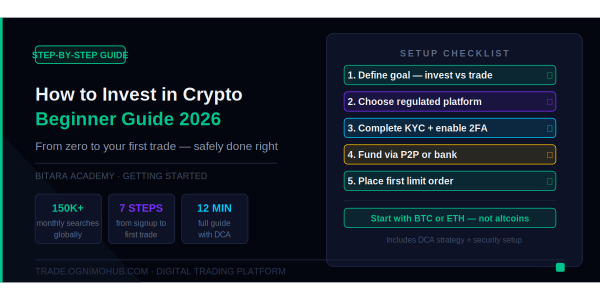
How to Invest in Cryptocurrency: The Step-by-Step Beginner Guide for 2026
By Bitara Academy · June 2026 · 12 min read
Start Here. Not With Price Predictions.
The most common way people start in crypto is wrong. They see Bitcoin at a new price level, they hear about someone who made life-changing money, and they open an exchange account and buy — with no framework, no security setup, no understanding of how to store what they bought or what to do when it drops 30%.
That sequence produces anxious holders who sell at the bottom of every correction.
This guide teaches the correct sequence: define your goal, choose the right platform, secure your account properly, understand what you are buying and why, execute your first purchase safely, and build a strategy that does not depend on perfect timing.
By the end of this post you will have a complete mental framework for starting in crypto — and specific steps you can take today on Bitara.
Step 1: Define What You Are Actually Trying to Do
Before touching an exchange, answer this question honestly: are you investing or trading?
Investing means buying assets you believe in and holding them through volatility for weeks, months, or years. Your goal is long-term appreciation. You are not watching charts daily. You accept that the value will fluctuate significantly. Your success metric is where you are in 12–24 months.
Trading means actively buying and selling to profit from short-term price movements. Your goal is to generate returns through market timing, technical analysis, and risk management. This requires significantly more time, knowledge, and emotional discipline than investing.
Most beginners should start as investors, not traders. Trading is a skill that takes months to develop and has a steep early learning curve. Attempting to trade before understanding the basics is one of the fastest ways to lose capital.
This does not mean you cannot trade eventually. It means you should sequence correctly: invest first, learn the market, develop analysis skills, then consider trading.
Define your risk tolerance honestly. Crypto markets are highly volatile. Bitcoin — the most established crypto asset — has historically experienced multiple 70–80% drawdowns from peak prices. Ethereum has seen similar moves. If seeing your investment drop by 50% would cause you to panic-sell, you either need to allocate less capital or develop a stronger understanding of market cycles before investing significantly.
A practical rule: invest only capital you can afford to have locked up for 1–3 years and that you could afford to lose entirely without damaging your financial position.
Step 2: Choose the Right Platform
Not all crypto platforms are equal. The platform you choose determines your security, fee structure, available assets, and access to different product types.
What to look for in a platform:
Regulation and compliance. A regulated platform is required to maintain segregated client funds, implement anti-money laundering procedures, and meet minimum security standards. This matters because unregulated platforms have no external accountability if something goes wrong. Bitara operates under compliance frameworks covering KYC and AML procedures.
Security infrastructure. Does the platform use cold storage for the majority of user funds? Does it offer two-factor authentication (2FA)? Has it been audited? Has it experienced hacks in its history and how were they handled?
Fee structure. Understand the trading fee (charged on every buy and sell — typically 0.1% on spot), withdrawal fees, and deposit fees. These compound over time. A platform charging 0.5% per trade versus 0.1% makes a significant difference to returns over hundreds of transactions.
Product range. Does it offer spot trading, P2P, futures, and copy trading? Starting with spot is recommended, but having access to additional products as your skills grow means you do not need to migrate platforms later.
Supported assets and payment methods. Does it support the assets you want to buy? Does it accept your local payment method — bank transfer, mobile money, or card?
Customer support. Responsive support is critical when you face issues with deposits, withdrawals, or account access. Test it before committing significant capital.
Step 3: Create and Secure Your Account
Once you have chosen Bitara, account creation takes approximately five minutes.
Registration: Enter your email address and create a strong, unique password. Use a password that is at least 16 characters and not used anywhere else. A password manager like Bitwarden or 1Password is strongly recommended.
KYC verification: Know Your Customer verification requires you to upload a government-issued photo ID and, in most cases, take a live selfie for facial matching. This is a legal requirement for regulated platforms and protects you — it ensures the platform can verify your identity in the event of account recovery or dispute resolution.
Most verifications complete within 5 to 30 minutes depending on volume. Completing KYC unlocks full account functionality including P2P trading and withdrawals.
Enable Two-Factor Authentication (2FA) immediately. This is the single most important security step. 2FA requires a second piece of information beyond your password to log in — typically a time-based code from an authenticator app on your phone (Google Authenticator or Authy are standard). Without 2FA, anyone who obtains your password has access to your account. With 2FA, they also need physical access to your phone.
Use an authenticator app — not SMS-based 2FA. SMS-based 2FA is vulnerable to SIM-swapping attacks, where a scammer convinces your mobile carrier to transfer your number to their device.
Save your backup codes. When setting up 2FA, the platform provides one-time backup codes. Store these offline — printed or written in a secure physical location. If you lose your phone without these codes, account recovery is significantly more complex.
Step 4: Fund Your Account
The fastest on-ramp in most markets is through Bitara's P2P marketplace — particularly for traders in Africa where direct bank crypto purchases can be restricted.
P2P funding: Browse sellers in the P2P marketplace who accept your preferred payment method (M-Pesa, bank transfer, Airtel, MTN). Select a seller with a high completion rate (95%+) and strong reputation. The platform holds their crypto in escrow. You send payment. They release the crypto. Your account is funded.
Bank transfer: Where available, direct bank transfers are the lowest-cost deposit method. Fees are typically zero on the deposit side, with trading fees applied only when you trade.
Debit/credit card: Higher convenience but also higher fees, typically 1.5–3.5% depending on the provider. Suitable for small initial deposits to get started, but bank or P2P is more cost-effective for larger amounts.
How much to start with: There is no minimum that makes sense for everyone. The key principle is to start with an amount you can afford to lose entirely — not because you expect to, but because it eliminates the emotional pressure of needing a specific outcome. Many successful investors started with the equivalent of $50–100 purely to learn the mechanics before committing meaningful capital.
Step 5: Understand What You Are Buying
Before placing your first order, spend fifteen minutes understanding the asset.
Bitcoin (BTC) is the original cryptocurrency. Created in 2008 by the pseudonymous Satoshi Nakamoto, it is a decentralised digital currency with a fixed maximum supply of 21 million coins. Approximately 19.7 million are already in circulation. It is the most liquid, most established, and most institutionally held crypto asset. Spot Bitcoin ETFs from BlackRock, Fidelity, and others are now available in the United States, creating a direct institutional demand channel. Bitcoin is where most new investors start.
Ethereum (ETH) is the second largest cryptocurrency by market capitalisation. Unlike Bitcoin, which is primarily a store of value and payment network, Ethereum is a programmable blockchain — a platform for building decentralised applications, smart contracts, stablecoins, and tokenised assets. The majority of DeFi, NFTs, and tokenised real world assets operate on Ethereum. It has more complex dynamics than Bitcoin but also more diverse use cases.
A practical starting allocation for beginners: most professional guidance suggests allocating 60–80% of a beginner crypto portfolio to BTC and ETH — the most established, most liquid, and most analytically transparent assets. The remaining 20–40% can be allocated to higher-conviction altcoins as knowledge develops, with the understanding that altcoins carry significantly higher risk and volatility.
Do not start by buying obscure tokens based on Telegram tips. That is speculation, not investing. Start with assets you understand.
Step 6: Place Your First Trade
On Bitara's spot trading interface:
Select your trading pair. For your first purchase, BTC/USDT or ETH/USDT. USDT is the stablecoin you are spending. BTC or ETH is what you are buying.
Choose your order type:
Market order: Executes immediately at the best available current price. Simple. Fast. The trade fills instantly. Slightly higher effective price due to the bid-ask spread, but for most beginners and most sizes this is negligible.
Limit order: You set the price at which you want to buy. The order only fills if the market reaches that price. Useful when you want to enter at a specific level rather than the current price. Does not fill immediately — it waits.
Stop-limit order: A limit order that is only placed once price reaches a certain trigger level. Used for more advanced entry strategies.
For your first trade: use a limit order at or slightly below the current price. This ensures you do not pay more than your intended price and gives you a small amount of patience-based discipline.
Enter your amount. You can buy fractional amounts of any asset. You do not need to buy a whole Bitcoin. $50 worth of BTC at $100,000 per Bitcoin gives you 0.0005 BTC. There is no minimum unit.
Review and confirm. Check the fee displayed. Confirm the total cost. Confirm your order.
Your asset will appear in your portfolio within seconds of the order filling.
Step 7: Build a Strategy That Does Not Depend on Perfect Timing
Dollar-Cost Averaging (DCA)
The most consistently recommended strategy for beginners is Dollar-Cost Averaging: buying a fixed amount of a specific asset at regular intervals — weekly or monthly — regardless of price.
The logic: you will sometimes buy high and sometimes buy low, but your average cost over time reflects the range of prices paid rather than a single entry point. This removes the impossible requirement of perfectly timing the market.
Example: Investing $100 in BTC every Monday for 52 weeks regardless of price. Some weeks you buy higher, some lower. Your average cost is the mean of 52 different prices. In a long-term uptrend, this average will likely be significantly below the eventual higher prices — producing gains without requiring any market timing skill.
DCA is particularly effective for volatile assets like crypto because it removes the emotional pressure of the entry decision. You execute the strategy mechanically, not emotionally.
Position Sizing
Never invest your entire allocated capital at once. Deploying capital in tranches — for example, three or four separate purchases over time — reduces the risk of a large single position at an unfavourable price.
Setting Exit Levels in Advance
Before you buy, decide:
- At what price or percentage gain will you take some profit?
- At what percentage loss will you accept that your thesis was wrong and exit?
These decisions are significantly easier to make before the emotion of a trade — when prices are rising and you feel the pull of greed, or falling and you feel the pull of fear. Written exit levels, set in advance, protect you from both.
Security After Your First Purchase
Once you have crypto in your account, security matters more than ever.
Use 2FA on every login. Already covered — but worth repeating.
Do not share your login details or 2FA codes with anyone. No Bitara support representative will ever ask for your password or 2FA code. If someone contacts you claiming to be from Bitara support and asks for these details, it is a scam.
Be cautious with withdrawal addresses. Before confirming any withdrawal, verify the destination address character by character. Some malware silently replaces cryptocurrency addresses in your clipboard with the attacker's address. Double-check every withdrawal.
Consider cold storage for long-term holdings. If you accumulate significant crypto holdings you intend to hold for months or years, consider a hardware wallet (Ledger or Trezor are the most established options). A hardware wallet stores your private keys offline — completely disconnected from the internet — making remote attacks impossible.
For active trading balances, a reputable exchange like Bitara with full security features enabled is appropriate. For long-term holdings, cold storage adds an important additional security layer.
What to Expect After Your First Month
Expect volatility. Crypto assets regularly move 5–15% in a single day. This is normal. Checking your portfolio multiple times per day is natural at first, but leads to emotional decision-making. Establish a review cadence — daily for active traders, weekly for investors — and stick to it.
Expect to learn from mistakes. Every experienced crypto investor has made costly errors. The ones who stayed and became proficient treated each mistake as information rather than failure.
Expect that the market will do things that seem inexplicable. Assets rise when news is bad. They fall when news is good. Seemingly random volatility occurs at 3 AM. All of this is normal in a market that trades 24/7 globally with a highly diverse participant base.
The investors who build meaningful positions over time are the ones who design a strategy that survives volatility — rather than one that requires volatility to stop.
Disclaimer: This content is for informational and educational purposes only and does not constitute financial advice. Cryptocurrency investments carry significant risk including the possible loss of all capital. Always conduct your own research.
Share This Post
By Bitara Academy · June 2026 · 12 min read
Start Here. Not With Price Predictions.
The most common way people start in crypto is wrong. They see Bitcoin at a new price level, they hear about someone who made life-changing money, and they open an exchange account and buy — with no framework, no security setup, no understanding of how to store what they bought or what to do when it drops 30%.
That sequence produces anxious holders who sell at the bottom of every correction.
This guide teaches the correct sequence: define your goal, choose the right platform, secure your account properly, understand what you are buying and why, execute your first purchase safely, and build a strategy that does not depend on perfect timing.
By the end of this post you will have a complete mental framework for starting in crypto — and specific steps you can take today on Bitara.
Step 1: Define What You Are Actually Trying to Do
Before touching an exchange, answer this question honestly: are you investing or trading?
Investing means buying assets you believe in and holding them through volatility for weeks, months, or years. Your goal is long-term appreciation. You are not watching charts daily. You accept that the value will fluctuate significantly. Your success metric is where you are in 12–24 months.
Trading means actively buying and selling to profit from short-term price movements. Your goal is to generate returns through market timing, technical analysis, and risk management. This requires significantly more time, knowledge, and emotional discipline than investing.
Most beginners should start as investors, not traders. Trading is a skill that takes months to develop and has a steep early learning curve. Attempting to trade before understanding the basics is one of the fastest ways to lose capital.
This does not mean you cannot trade eventually. It means you should sequence correctly: invest first, learn the market, develop analysis skills, then consider trading.
Define your risk tolerance honestly. Crypto markets are highly volatile. Bitcoin — the most established crypto asset — has historically experienced multiple 70–80% drawdowns from peak prices. Ethereum has seen similar moves. If seeing your investment drop by 50% would cause you to panic-sell, you either need to allocate less capital or develop a stronger understanding of market cycles before investing significantly.
A practical rule: invest only capital you can afford to have locked up for 1–3 years and that you could afford to lose entirely without damaging your financial position.
Step 2: Choose the Right Platform
Not all crypto platforms are equal. The platform you choose determines your security, fee structure, available assets, and access to different product types.
What to look for in a platform:
Regulation and compliance. A regulated platform is required to maintain segregated client funds, implement anti-money laundering procedures, and meet minimum security standards. This matters because unregulated platforms have no external accountability if something goes wrong. Bitara operates under compliance frameworks covering KYC and AML procedures.
Security infrastructure. Does the platform use cold storage for the majority of user funds? Does it offer two-factor authentication (2FA)? Has it been audited? Has it experienced hacks in its history and how were they handled?
Fee structure. Understand the trading fee (charged on every buy and sell — typically 0.1% on spot), withdrawal fees, and deposit fees. These compound over time. A platform charging 0.5% per trade versus 0.1% makes a significant difference to returns over hundreds of transactions.
Product range. Does it offer spot trading, P2P, futures, and copy trading? Starting with spot is recommended, but having access to additional products as your skills grow means you do not need to migrate platforms later.
Supported assets and payment methods. Does it support the assets you want to buy? Does it accept your local payment method — bank transfer, mobile money, or card?
Customer support. Responsive support is critical when you face issues with deposits, withdrawals, or account access. Test it before committing significant capital.
Step 3: Create and Secure Your Account
Once you have chosen Bitara, account creation takes approximately five minutes.
Registration: Enter your email address and create a strong, unique password. Use a password that is at least 16 characters and not used anywhere else. A password manager like Bitwarden or 1Password is strongly recommended.
KYC verification: Know Your Customer verification requires you to upload a government-issued photo ID and, in most cases, take a live selfie for facial matching. This is a legal requirement for regulated platforms and protects you — it ensures the platform can verify your identity in the event of account recovery or dispute resolution.
Most verifications complete within 5 to 30 minutes depending on volume. Completing KYC unlocks full account functionality including P2P trading and withdrawals.
Enable Two-Factor Authentication (2FA) immediately. This is the single most important security step. 2FA requires a second piece of information beyond your password to log in — typically a time-based code from an authenticator app on your phone (Google Authenticator or Authy are standard). Without 2FA, anyone who obtains your password has access to your account. With 2FA, they also need physical access to your phone.
Use an authenticator app — not SMS-based 2FA. SMS-based 2FA is vulnerable to SIM-swapping attacks, where a scammer convinces your mobile carrier to transfer your number to their device.
Save your backup codes. When setting up 2FA, the platform provides one-time backup codes. Store these offline — printed or written in a secure physical location. If you lose your phone without these codes, account recovery is significantly more complex.
Step 4: Fund Your Account
The fastest on-ramp in most markets is through Bitara's P2P marketplace — particularly for traders in Africa where direct bank crypto purchases can be restricted.
P2P funding: Browse sellers in the P2P marketplace who accept your preferred payment method (M-Pesa, bank transfer, Airtel, MTN). Select a seller with a high completion rate (95%+) and strong reputation. The platform holds their crypto in escrow. You send payment. They release the crypto. Your account is funded.
Bank transfer: Where available, direct bank transfers are the lowest-cost deposit method. Fees are typically zero on the deposit side, with trading fees applied only when you trade.
Debit/credit card: Higher convenience but also higher fees, typically 1.5–3.5% depending on the provider. Suitable for small initial deposits to get started, but bank or P2P is more cost-effective for larger amounts.
How much to start with: There is no minimum that makes sense for everyone. The key principle is to start with an amount you can afford to lose entirely — not because you expect to, but because it eliminates the emotional pressure of needing a specific outcome. Many successful investors started with the equivalent of $50–100 purely to learn the mechanics before committing meaningful capital.
Step 5: Understand What You Are Buying
Before placing your first order, spend fifteen minutes understanding the asset.
Bitcoin (BTC) is the original cryptocurrency. Created in 2008 by the pseudonymous Satoshi Nakamoto, it is a decentralised digital currency with a fixed maximum supply of 21 million coins. Approximately 19.7 million are already in circulation. It is the most liquid, most established, and most institutionally held crypto asset. Spot Bitcoin ETFs from BlackRock, Fidelity, and others are now available in the United States, creating a direct institutional demand channel. Bitcoin is where most new investors start.
Ethereum (ETH) is the second largest cryptocurrency by market capitalisation. Unlike Bitcoin, which is primarily a store of value and payment network, Ethereum is a programmable blockchain — a platform for building decentralised applications, smart contracts, stablecoins, and tokenised assets. The majority of DeFi, NFTs, and tokenised real world assets operate on Ethereum. It has more complex dynamics than Bitcoin but also more diverse use cases.
A practical starting allocation for beginners: most professional guidance suggests allocating 60–80% of a beginner crypto portfolio to BTC and ETH — the most established, most liquid, and most analytically transparent assets. The remaining 20–40% can be allocated to higher-conviction altcoins as knowledge develops, with the understanding that altcoins carry significantly higher risk and volatility.
Do not start by buying obscure tokens based on Telegram tips. That is speculation, not investing. Start with assets you understand.
Step 6: Place Your First Trade
On Bitara's spot trading interface:
Select your trading pair. For your first purchase, BTC/USDT or ETH/USDT. USDT is the stablecoin you are spending. BTC or ETH is what you are buying.
Choose your order type:
Market order: Executes immediately at the best available current price. Simple. Fast. The trade fills instantly. Slightly higher effective price due to the bid-ask spread, but for most beginners and most sizes this is negligible.
Limit order: You set the price at which you want to buy. The order only fills if the market reaches that price. Useful when you want to enter at a specific level rather than the current price. Does not fill immediately — it waits.
Stop-limit order: A limit order that is only placed once price reaches a certain trigger level. Used for more advanced entry strategies.
For your first trade: use a limit order at or slightly below the current price. This ensures you do not pay more than your intended price and gives you a small amount of patience-based discipline.
Enter your amount. You can buy fractional amounts of any asset. You do not need to buy a whole Bitcoin. $50 worth of BTC at $100,000 per Bitcoin gives you 0.0005 BTC. There is no minimum unit.
Review and confirm. Check the fee displayed. Confirm the total cost. Confirm your order.
Your asset will appear in your portfolio within seconds of the order filling.
Step 7: Build a Strategy That Does Not Depend on Perfect Timing
Dollar-Cost Averaging (DCA)
The most consistently recommended strategy for beginners is Dollar-Cost Averaging: buying a fixed amount of a specific asset at regular intervals — weekly or monthly — regardless of price.
The logic: you will sometimes buy high and sometimes buy low, but your average cost over time reflects the range of prices paid rather than a single entry point. This removes the impossible requirement of perfectly timing the market.
Example: Investing $100 in BTC every Monday for 52 weeks regardless of price. Some weeks you buy higher, some lower. Your average cost is the mean of 52 different prices. In a long-term uptrend, this average will likely be significantly below the eventual higher prices — producing gains without requiring any market timing skill.
DCA is particularly effective for volatile assets like crypto because it removes the emotional pressure of the entry decision. You execute the strategy mechanically, not emotionally.
Position Sizing
Never invest your entire allocated capital at once. Deploying capital in tranches — for example, three or four separate purchases over time — reduces the risk of a large single position at an unfavourable price.
Setting Exit Levels in Advance
Before you buy, decide:
- At what price or percentage gain will you take some profit?
- At what percentage loss will you accept that your thesis was wrong and exit?
These decisions are significantly easier to make before the emotion of a trade — when prices are rising and you feel the pull of greed, or falling and you feel the pull of fear. Written exit levels, set in advance, protect you from both.
Security After Your First Purchase
Once you have crypto in your account, security matters more than ever.
Use 2FA on every login. Already covered — but worth repeating.
Do not share your login details or 2FA codes with anyone. No Bitara support representative will ever ask for your password or 2FA code. If someone contacts you claiming to be from Bitara support and asks for these details, it is a scam.
Be cautious with withdrawal addresses. Before confirming any withdrawal, verify the destination address character by character. Some malware silently replaces cryptocurrency addresses in your clipboard with the attacker's address. Double-check every withdrawal.
Consider cold storage for long-term holdings. If you accumulate significant crypto holdings you intend to hold for months or years, consider a hardware wallet (Ledger or Trezor are the most established options). A hardware wallet stores your private keys offline — completely disconnected from the internet — making remote attacks impossible.
For active trading balances, a reputable exchange like Bitara with full security features enabled is appropriate. For long-term holdings, cold storage adds an important additional security layer.
What to Expect After Your First Month
Expect volatility. Crypto assets regularly move 5–15% in a single day. This is normal. Checking your portfolio multiple times per day is natural at first, but leads to emotional decision-making. Establish a review cadence — daily for active traders, weekly for investors — and stick to it.
Expect to learn from mistakes. Every experienced crypto investor has made costly errors. The ones who stayed and became proficient treated each mistake as information rather than failure.
Expect that the market will do things that seem inexplicable. Assets rise when news is bad. They fall when news is good. Seemingly random volatility occurs at 3 AM. All of this is normal in a market that trades 24/7 globally with a highly diverse participant base.
The investors who build meaningful positions over time are the ones who design a strategy that survives volatility — rather than one that requires volatility to stop.
Disclaimer: This content is for informational and educational purposes only and does not constitute financial advice. Cryptocurrency investments carry significant risk including the possible loss of all capital. Always conduct your own research.