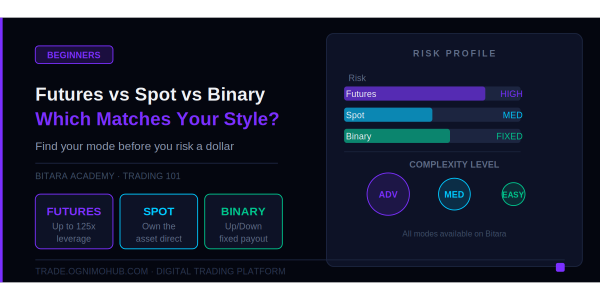
Futures vs Spot vs Binary: Which Trading Mode Actually Matches Your Risk Personality?
By Bitara Academy · May 2026 · 10 min read
The Question Every New Trader Gets Wrong
When most people join a crypto trading platform, they ask: "Which coin should I buy?" The better question — the one that determines whether they are profitable or not — is: "Which trading mode should I be using?"
Bitara offers five trading environments: spot, futures, binary options, P2P, and copy trading. Each is built for a different trader profile, a different time horizon, and a different relationship with risk. Using the wrong mode for your personality and situation is one of the most common and costly mistakes in crypto.
This post breaks down the three primary trading modes — spot, futures, and binary — with enough depth that you can make an honest assessment of which one fits you right now. Not eventually. Now.
Mode 1: Spot Trading — Own the Asset, Own the Outcome
What It Is
Spot trading is the most direct form of crypto participation. You buy a cryptocurrency at its current market price, it is transferred to your trading account, and you own it. When you sell, the transaction completes instantly at the prevailing price.
There is no leverage. No expiry date. No funding rate. No liquidation risk. Your maximum loss on a spot position is 100% of what you invested — and that is only if the asset goes to zero.
How It Works on Bitara
You select a trading pair — BTC/USDT, ETH/USDT, or any of the assets listed — place a buy order (market, limit, or stop-limit), and the asset appears in your account. You hold it for as long as you choose. You sell when you reach your target or when your thesis changes.
Who Spot Trading Is For
Spot trading is the correct starting point for most traders. If you are new to crypto, unclear on technical analysis, or still building conviction in specific assets, spot is where you should be. The absence of leverage means your mistakes cost you proportionally — a 10% adverse move costs you 10% of your investment, not 50% or 100%.
The spot trader profile:
- Time horizon: days to months (or longer)
- Risk tolerance: moderate, defined by position size
- Primary goal: capital appreciation on assets held directly
- Experience required: beginner to intermediate
Spot Trading Advantages
- Simplicity: buy, hold, sell — no complex mechanics to master
- Ownership: you hold the actual asset and benefit from any airdrops, forks, or yield
- No liquidation: the position stays open as long as you hold it regardless of price movement
- No funding costs: holding a spot position costs nothing beyond the spread on entry and exit
- Lower stress: without leverage, normal market volatility does not threaten your position existence
Spot Trading Limitations
- Cannot profit from falling prices (unless you sell first and rebuy lower)
- Capital intensive: to control a $10,000 BTC position, you need $10,000
- Gains limited to price appreciation: no leverage multiplier
Mode 2: Futures Trading — Precision, Leverage, and Directionality
What It Is
Futures trading means you trade a contract that tracks the price of a cryptocurrency — you do not own the underlying asset. This gives you three capabilities that spot trading does not: leverage, the ability to short (profit from price falls), and capital efficiency.
The dominant form of crypto futures in 2026 is the perpetual contract — a futures contract with no expiry date. Perpetuals track the spot price through a funding rate mechanism and represent approximately 82% of total crypto exchange volume.
How It Works on Bitara
You select a futures pair, choose your leverage (2x to 125x on Bitara), and open either a long position (you profit if price rises) or a short position (you profit if price falls). Your margin is the collateral — futures in 2026 represent roughly 77% of total crypto trading volume, making this the professional trader's primary environment.
Key mechanics to understand:
- Mark price: the price used to calculate your unrealised P&L and liquidation — not the last traded price
- Funding rate: periodic payment between longs and shorts, typically every 8 hours
- Liquidation price: the price at which your margin is exhausted and position is force-closed
- Isolated vs. cross margin: isolated limits risk to that position; cross uses your full account balance
Who Futures Trading Is For
Futures trading rewards traders who have developed market structure understanding, position sizing discipline, and emotional control. It is not appropriate for complete beginners — the leverage mechanics require genuine comprehension before deployment.
The futures trader profile:
- Time horizon: minutes to weeks
- Risk tolerance: variable (controlled by leverage and position sizing)
- Primary goal: capitalising on directional moves in either direction
- Experience required: intermediate to advanced
Futures Trading Advantages
- Leverage: control large positions with smaller capital
- Short selling: profit from falling prices
- Hedging: protect spot holdings during uncertain periods
- Deep liquidity: Bitcoin futures alone see $2 trillion in monthly volume
- 24/7 markets: perpetuals never expire, no rollover required
Futures Trading Limitations
- Liquidation risk: adverse moves can eliminate your margin entirely
- Funding rate drag: holding leveraged longs in bull markets costs capital continuously
- Complexity: mark prices, funding rates, margin modes require genuine understanding
- Emotional demands: leverage amplifies both P&L and psychological pressure
Mode 3: Binary Options — Defined Risk, Fixed Outcome
What It Is
Binary options are the simplest derivative instrument available. You answer one question: will this asset be above or below a specific price at a specific time? If you are correct, you receive a fixed payout. If you are wrong, you lose your stake. The risk is defined from the moment you open the position — you cannot lose more than you risked.
This "binary" structure — two possible outcomes with fixed payouts — makes binary options fundamentally different from futures and spot in their risk profile.
How It Works on Bitara
You select an asset, a target price, a time frame (typically ranging from minutes to hours), and a direction (call = price above target / put = price below target). You stake an amount. At expiry, if correct, you receive your stake plus a fixed payout percentage (typically 70–90%). If incorrect, you lose your stake.
Example:
- BTC is at $67,000
- You believe it will be above $67,500 in 1 hour
- You stake $100 on a "call" binary at $67,500 with 80% payout
- If BTC is above $67,500 at expiry: you receive $180 ($100 stake + $80 profit)
- If BTC is at or below $67,500 at expiry: you lose your $100 stake
Who Binary Options Are For
Binary options suit traders who want short-term exposure with completely defined risk on each position. They work well for:
- Traders who have clear catalyst views (central bank decisions, key resistance levels, earnings-equivalent events in crypto)
- Risk-sensitive traders who need to know their maximum loss before entering
- Experienced spot/futures traders who want to add a short-duration instrument to their toolkit
- Traders who want to participate in market moves without managing stop-losses, funding rates, or liquidation mechanics
The binary trader profile:
- Time horizon: minutes to hours
- Risk tolerance: defined (maximum loss = stake)
- Primary goal: short-term directional prediction with fixed risk/reward
- Experience required: intermediate (requires directional conviction; not suitable for complete beginners)
Binary Options Advantages
- Defined maximum loss: you know exactly what you risk before entering
- No liquidation: the position simply expires at a predetermined time
- No funding rates: binary positions do not carry overnight costs
- Simplicity of outcome: right or wrong — no managing of ongoing position
- Fixed time horizon: removes the emotional trap of holding losing positions
Binary Options Limitations
- All-or-nothing structure: being 99% right and expiring just outside the strike is the same as being completely wrong
- Payout capped: even if the asset moves 20% in your direction, you receive only the fixed payout
- Requires precision: short time frames demand accurate market timing
- Not suitable for trending positions: not designed for holding through multi-day moves
Side-by-Side Comparison
Spot
Futures
Binary
Asset ownership
Yes
No
No
Maximum loss
100% of position
100% of margin
100% of stake
Leverage
None
2x–125x
Implicit (payout)
Short selling
No
Yes
Yes (put options)
Time horizon
Open-ended
Open-ended
Fixed expiry
Funding rate
None
Yes (perps)
None
Liquidation risk
None
Yes
None
Complexity
Low
High
Medium
Best for
Accumulation, HODL, beginners
Active trading, hedging, professionals
Short-term catalysts, defined risk
How to Choose Your Mode: An Honest Framework
Choose Spot If:
You are building a long-term crypto portfolio, you are new to trading mechanics, you prefer lower stress, or you want to accumulate assets through market cycles. Spot is also the correct mode if you do not yet have a trading strategy with defined entries, exits, and position sizing.
Choose Futures If:
You have a solid understanding of technical analysis, you have practised position sizing and stop-loss placement, you want to profit from both rising and falling markets, or you want to hedge an existing spot portfolio. Futures is also the correct mode for short-term tactical trades where leverage meaningfully improves your return profile.
Choose Binary If:
You have a specific short-term directional view based on a catalyst or technical level, you want completely defined risk per position, you do not want to manage stop-losses or funding rates, or you are adding a short-duration tool to complement an existing spot or futures strategy.
The Multi-Mode Approach: What Professional Bitara Traders Do
The most effective traders do not exclusively use one mode. A common professional allocation on Bitara looks like this:
- 50–60% Spot: core positions in BTC, ETH, and high-conviction altcoins, held through market cycles
- 30–40% Futures: tactical trades on shorter timeframes, using leverage with strict position sizing
- 10–15% Binary: catalyst-driven short-term bets (halving events, major technical breakouts, macro announcements)
- Copy trading overlay: following 2–3 lead traders in sectors where you lack direct research (specific altcoin narratives, for example)
This multi-mode approach captures different types of market opportunity — long-term accumulation, tactical leverage, and short-term catalysts — while managing risk across all three simultaneously.
The Bottom Line
The trading mode you choose is as important as the asset you trade. Getting this match right — between your experience level, time availability, risk tolerance, and chosen instrument — is the foundation of sustainable profitability.
Start with spot. Understand the market. Develop conviction. Then add futures carefully, with proper risk management. Layer binary options for specific high-conviction short-term views when the setup is right.
All three modes are available on Bitara. The platform does not prescribe which you use. Your results depend on whether you are honest with yourself about which one fits who you are as a trader right now.
Share This Post
By Bitara Academy · May 2026 · 10 min read
The Question Every New Trader Gets Wrong
When most people join a crypto trading platform, they ask: "Which coin should I buy?" The better question — the one that determines whether they are profitable or not — is: "Which trading mode should I be using?"
Bitara offers five trading environments: spot, futures, binary options, P2P, and copy trading. Each is built for a different trader profile, a different time horizon, and a different relationship with risk. Using the wrong mode for your personality and situation is one of the most common and costly mistakes in crypto.
This post breaks down the three primary trading modes — spot, futures, and binary — with enough depth that you can make an honest assessment of which one fits you right now. Not eventually. Now.
Mode 1: Spot Trading — Own the Asset, Own the Outcome
What It Is
Spot trading is the most direct form of crypto participation. You buy a cryptocurrency at its current market price, it is transferred to your trading account, and you own it. When you sell, the transaction completes instantly at the prevailing price.
There is no leverage. No expiry date. No funding rate. No liquidation risk. Your maximum loss on a spot position is 100% of what you invested — and that is only if the asset goes to zero.
How It Works on Bitara
You select a trading pair — BTC/USDT, ETH/USDT, or any of the assets listed — place a buy order (market, limit, or stop-limit), and the asset appears in your account. You hold it for as long as you choose. You sell when you reach your target or when your thesis changes.
Who Spot Trading Is For
Spot trading is the correct starting point for most traders. If you are new to crypto, unclear on technical analysis, or still building conviction in specific assets, spot is where you should be. The absence of leverage means your mistakes cost you proportionally — a 10% adverse move costs you 10% of your investment, not 50% or 100%.
The spot trader profile:
- Time horizon: days to months (or longer)
- Risk tolerance: moderate, defined by position size
- Primary goal: capital appreciation on assets held directly
- Experience required: beginner to intermediate
Spot Trading Advantages
- Simplicity: buy, hold, sell — no complex mechanics to master
- Ownership: you hold the actual asset and benefit from any airdrops, forks, or yield
- No liquidation: the position stays open as long as you hold it regardless of price movement
- No funding costs: holding a spot position costs nothing beyond the spread on entry and exit
- Lower stress: without leverage, normal market volatility does not threaten your position existence
Spot Trading Limitations
- Cannot profit from falling prices (unless you sell first and rebuy lower)
- Capital intensive: to control a $10,000 BTC position, you need $10,000
- Gains limited to price appreciation: no leverage multiplier
Mode 2: Futures Trading — Precision, Leverage, and Directionality
What It Is
Futures trading means you trade a contract that tracks the price of a cryptocurrency — you do not own the underlying asset. This gives you three capabilities that spot trading does not: leverage, the ability to short (profit from price falls), and capital efficiency.
The dominant form of crypto futures in 2026 is the perpetual contract — a futures contract with no expiry date. Perpetuals track the spot price through a funding rate mechanism and represent approximately 82% of total crypto exchange volume.
How It Works on Bitara
You select a futures pair, choose your leverage (2x to 125x on Bitara), and open either a long position (you profit if price rises) or a short position (you profit if price falls). Your margin is the collateral — futures in 2026 represent roughly 77% of total crypto trading volume, making this the professional trader's primary environment.
Key mechanics to understand:
- Mark price: the price used to calculate your unrealised P&L and liquidation — not the last traded price
- Funding rate: periodic payment between longs and shorts, typically every 8 hours
- Liquidation price: the price at which your margin is exhausted and position is force-closed
- Isolated vs. cross margin: isolated limits risk to that position; cross uses your full account balance
Who Futures Trading Is For
Futures trading rewards traders who have developed market structure understanding, position sizing discipline, and emotional control. It is not appropriate for complete beginners — the leverage mechanics require genuine comprehension before deployment.
The futures trader profile:
- Time horizon: minutes to weeks
- Risk tolerance: variable (controlled by leverage and position sizing)
- Primary goal: capitalising on directional moves in either direction
- Experience required: intermediate to advanced
Futures Trading Advantages
- Leverage: control large positions with smaller capital
- Short selling: profit from falling prices
- Hedging: protect spot holdings during uncertain periods
- Deep liquidity: Bitcoin futures alone see $2 trillion in monthly volume
- 24/7 markets: perpetuals never expire, no rollover required
Futures Trading Limitations
- Liquidation risk: adverse moves can eliminate your margin entirely
- Funding rate drag: holding leveraged longs in bull markets costs capital continuously
- Complexity: mark prices, funding rates, margin modes require genuine understanding
- Emotional demands: leverage amplifies both P&L and psychological pressure
Mode 3: Binary Options — Defined Risk, Fixed Outcome
What It Is
Binary options are the simplest derivative instrument available. You answer one question: will this asset be above or below a specific price at a specific time? If you are correct, you receive a fixed payout. If you are wrong, you lose your stake. The risk is defined from the moment you open the position — you cannot lose more than you risked.
This "binary" structure — two possible outcomes with fixed payouts — makes binary options fundamentally different from futures and spot in their risk profile.
How It Works on Bitara
You select an asset, a target price, a time frame (typically ranging from minutes to hours), and a direction (call = price above target / put = price below target). You stake an amount. At expiry, if correct, you receive your stake plus a fixed payout percentage (typically 70–90%). If incorrect, you lose your stake.
Example:
- BTC is at $67,000
- You believe it will be above $67,500 in 1 hour
- You stake $100 on a "call" binary at $67,500 with 80% payout
- If BTC is above $67,500 at expiry: you receive $180 ($100 stake + $80 profit)
- If BTC is at or below $67,500 at expiry: you lose your $100 stake
Who Binary Options Are For
Binary options suit traders who want short-term exposure with completely defined risk on each position. They work well for:
- Traders who have clear catalyst views (central bank decisions, key resistance levels, earnings-equivalent events in crypto)
- Risk-sensitive traders who need to know their maximum loss before entering
- Experienced spot/futures traders who want to add a short-duration instrument to their toolkit
- Traders who want to participate in market moves without managing stop-losses, funding rates, or liquidation mechanics
The binary trader profile:
- Time horizon: minutes to hours
- Risk tolerance: defined (maximum loss = stake)
- Primary goal: short-term directional prediction with fixed risk/reward
- Experience required: intermediate (requires directional conviction; not suitable for complete beginners)
Binary Options Advantages
- Defined maximum loss: you know exactly what you risk before entering
- No liquidation: the position simply expires at a predetermined time
- No funding rates: binary positions do not carry overnight costs
- Simplicity of outcome: right or wrong — no managing of ongoing position
- Fixed time horizon: removes the emotional trap of holding losing positions
Binary Options Limitations
- All-or-nothing structure: being 99% right and expiring just outside the strike is the same as being completely wrong
- Payout capped: even if the asset moves 20% in your direction, you receive only the fixed payout
- Requires precision: short time frames demand accurate market timing
- Not suitable for trending positions: not designed for holding through multi-day moves
Side-by-Side Comparison
| Spot | Futures | Binary | |
|---|---|---|---|
| Asset ownership | Yes | No | No |
| Maximum loss | 100% of position | 100% of margin | 100% of stake |
| Leverage | None | 2x–125x | Implicit (payout) |
| Short selling | No | Yes | Yes (put options) |
| Time horizon | Open-ended | Open-ended | Fixed expiry |
| Funding rate | None | Yes (perps) | None |
| Liquidation risk | None | Yes | None |
| Complexity | Low | High | Medium |
| Best for | Accumulation, HODL, beginners | Active trading, hedging, professionals | Short-term catalysts, defined risk |
How to Choose Your Mode: An Honest Framework
Choose Spot If:
You are building a long-term crypto portfolio, you are new to trading mechanics, you prefer lower stress, or you want to accumulate assets through market cycles. Spot is also the correct mode if you do not yet have a trading strategy with defined entries, exits, and position sizing.
Choose Futures If:
You have a solid understanding of technical analysis, you have practised position sizing and stop-loss placement, you want to profit from both rising and falling markets, or you want to hedge an existing spot portfolio. Futures is also the correct mode for short-term tactical trades where leverage meaningfully improves your return profile.
Choose Binary If:
You have a specific short-term directional view based on a catalyst or technical level, you want completely defined risk per position, you do not want to manage stop-losses or funding rates, or you are adding a short-duration tool to complement an existing spot or futures strategy.
The Multi-Mode Approach: What Professional Bitara Traders Do
The most effective traders do not exclusively use one mode. A common professional allocation on Bitara looks like this:
- 50–60% Spot: core positions in BTC, ETH, and high-conviction altcoins, held through market cycles
- 30–40% Futures: tactical trades on shorter timeframes, using leverage with strict position sizing
- 10–15% Binary: catalyst-driven short-term bets (halving events, major technical breakouts, macro announcements)
- Copy trading overlay: following 2–3 lead traders in sectors where you lack direct research (specific altcoin narratives, for example)
This multi-mode approach captures different types of market opportunity — long-term accumulation, tactical leverage, and short-term catalysts — while managing risk across all three simultaneously.
The Bottom Line
The trading mode you choose is as important as the asset you trade. Getting this match right — between your experience level, time availability, risk tolerance, and chosen instrument — is the foundation of sustainable profitability.
Start with spot. Understand the market. Develop conviction. Then add futures carefully, with proper risk management. Layer binary options for specific high-conviction short-term views when the setup is right.
All three modes are available on Bitara. The platform does not prescribe which you use. Your results depend on whether you are honest with yourself about which one fits who you are as a trader right now.