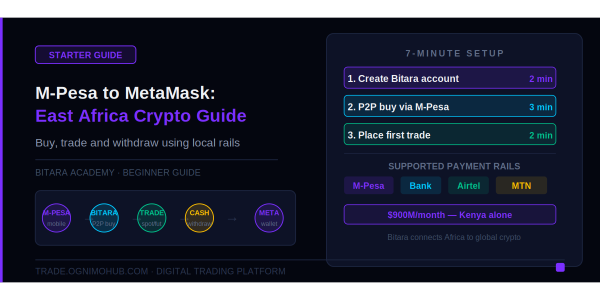
From M-Pesa to MetaMask: The Complete Guide to Buying, Trading and Withdrawing Crypto in East Africa
By Bitara Academy · Beginner Guide · May 2026 · 12 min read
You Already Use Digital Money. Crypto Is the Next Step.
If you use M-Pesa, you already understand the core principle of digital money. You hold value on a network, transfer it to other people, and convert it to cash when you need to. The infrastructure is different. The principle is identical.
Crypto in East Africa is not a leap of faith. It is an extension of a financial behaviour that millions of Kenyans, Tanzanians, and Ugandans already practice daily. The difference is that crypto adds a dimension M-Pesa cannot offer: global access, dollar stability through stablecoins, and the ability to earn returns through trading.
This guide takes you from your first M-Pesa deposit to your first completed trade — step by step, with no assumed knowledge.
Step 1: Create Your Bitara Account (2 Minutes)
Visit trade.ognimohub.com on your phone browser or download the Bitara app.
The registration process requires:
- A valid email address or phone number
- A password
- Identity verification (government-issued ID and selfie) — required for P2P trading and withdrawals
Identity verification typically completes within 5–10 minutes for Kenyan, Tanzanian, and Ugandan national IDs. This step is not bureaucracy — it is the mechanism that enables you to dispute transactions and access full platform functionality, including withdrawals to mobile money.
Why verification matters: Unverified accounts are limited to small transaction amounts. Verified accounts have full access to P2P trading, direct withdrawals to M-Pesa, and copy trading. Complete this step first.
Step 2: Fund Your Account via P2P (3 Minutes)
The fastest and most cost-effective way to fund a Bitara account in East Africa is through P2P trading. Here is how it works:
Navigate to the P2P marketplace on Bitara. You will see a list of sellers offering USDT in exchange for Kenyan Shillings (or your local currency). Each listing shows the seller's exchange rate, payment methods accepted, and their reputation score.
What to look for in a P2P seller:
- High completion rate (95%+ is the benchmark)
- Fast average release time (under 15 minutes)
- Payment methods that include M-Pesa or your preferred mobile money provider
- Reputation score with meaningful volume (not a new account)
Select a seller offering M-Pesa payments. Enter the amount you want to purchase (start small for your first transaction — 500 KES to 1,000 KES is appropriate). The platform holds the USDT in escrow.
Follow the seller's payment instructions. Send the M-Pesa payment to their number. Upload the M-Pesa confirmation screenshot within the platform. The seller releases the USDT from escrow to your Bitara wallet.
Important: Never send M-Pesa payment outside the Bitara platform interface. Always use the in-platform payment confirmation system. This is what activates the escrow release and provides dispute protection.
Step 3: Your First Trade (2 Minutes)
With USDT in your account, you can trade any of the assets listed on Bitara's spot market. For your first trade, stick to spot trading — no leverage, just direct asset ownership.
Recommended first trade:
- Navigate to Spot Trading
- Select BTC/USDT or ETH/USDT
- Choose a "Limit Order" rather than a market order
- Set your price slightly below the current price (this ensures you buy at your chosen level, not the current level)
- Enter the amount (start with the equivalent of $10–$20)
- Confirm
Your order will fill when the market price reaches your limit. You now own Bitcoin or Ethereum.
What to do next:
- Set a take-profit level: the price at which you want to sell and take gains
- Set a stop-loss level: the price at which you want to exit if the trade goes against you
- Do not check the price every five minutes — hourly or daily review is sufficient for a spot trade
Step 4: Understanding Your Options on Bitara
Once comfortable with basic spot trading, Bitara's full product suite becomes accessible:
Spot Trading: Buy and hold crypto directly. Best for building a portfolio over time. No leverage, no liquidation risk.
Futures Trading: Trade contracts with leverage. Profit from both rising and falling prices. Requires understanding of margin, stop-losses, and liquidation. Appropriate after you have completed at least 20–30 spot trades and understand market structure.
P2P Trading: Buy and sell crypto directly with other users. The best on-ramp and off-ramp for East African traders. Use it to convert between mobile money and USDT without bank intermediaries.
Copy Trading: Automatically mirror the trades of experienced traders. Good for building exposure while learning. Start with a small allocation (10–20% of your trading capital) and track the lead trader's performance for at least 30 days before increasing allocation.
Binary Options: Short-term directional bets with fixed risk. Appropriate for specific catalyst-driven trades once you have a clear market view.
Step 5: Withdrawing Back to M-Pesa
Withdrawing funds from Bitara to M-Pesa follows the reverse P2P process:
Navigate to P2P and look for buyers offering to purchase USDT for Kenyan Shillings. Select a buyer with a high completion rate and M-Pesa as their payment method. Enter the amount you want to sell. The platform holds your USDT in escrow. The buyer sends M-Pesa to your registered number. You confirm receipt and the USDT is released.
Typical timeframes: Most P2P transactions in Kenya complete within 5–15 minutes during active trading hours (8 AM – 10 PM EAT). For larger amounts, verify that the buyer has adequate M-Pesa liquidity before initiating.
Alternative withdrawal routes:
- Bank transfer (for users with formal bank accounts)
- Airtel Money
- Other mobile money platforms listed by verified P2P users
The East Africa Crypto Ecosystem: Key Numbers
- Kenya monthly P2P trading volume: $900 million+
- Kenya mobile money users: 40 million+ (M-Pesa alone)
- Cost of sending $500 via Western Union: $40–60 (8–12% fee)
- Cost of sending $500 via USDT P2P: under $2 (0.3% fee)
- M-Pesa settlement: 3–5 days for bank transfers, instant for mobile money
- USDT settlement: 1–5 minutes on most blockchains
- Tanzania, Uganda, Rwanda: rapidly growing P2P ecosystems following Kenya's model
Common Mistakes First-Time East African Crypto Traders Make
Sending M-Pesa outside the escrow system. If a P2P counterparty asks you to send payment to a number not provided within the Bitara escrow interface, this is a fraud attempt. All legitimate P2P transactions run through escrow. Stop and report.
Using maximum leverage on first futures trades. The platform allows up to 125x leverage. Your first futures trades should use 2x or 3x at most. Build understanding of liquidation mechanics before increasing leverage.
Not setting stop-losses. Every trade — spot or futures — should have a defined exit level. Set it when you enter. Do not rely on monitoring the price manually.
Sending to wrong blockchain network. When withdrawing USDT, ensure you are sending on the correct network (TRC-20 for Tron, ERC-20 for Ethereum, BEP-20 for BNB Chain). Sending on the wrong network results in lost funds that are extremely difficult to recover.
Starting with too much capital. Your first month on any platform should use a small amount — enough to learn the mechanics without material financial risk. Proficiency grows with practice. Capital should follow proficiency, not precede it.
The Bigger Picture
M-Pesa transformed Kenya's financial system by making digital payments accessible to people without bank accounts. Crypto is the next layer — it extends that transformation globally, adding store-of-value functionality, trading returns, and access to the global dollar economy.
The infrastructure exists. The regulatory framework is being built. The $900 million in monthly Kenyan P2P volume demonstrates the demand is real.
The traders who learn these tools now — before the mainstream adoption wave fully materialises — are positioning themselves at the front of a transformation that is already underway.
Trade. Learn. Compound.
Share This Post
By Bitara Academy · Beginner Guide · May 2026 · 12 min read
You Already Use Digital Money. Crypto Is the Next Step.
If you use M-Pesa, you already understand the core principle of digital money. You hold value on a network, transfer it to other people, and convert it to cash when you need to. The infrastructure is different. The principle is identical.
Crypto in East Africa is not a leap of faith. It is an extension of a financial behaviour that millions of Kenyans, Tanzanians, and Ugandans already practice daily. The difference is that crypto adds a dimension M-Pesa cannot offer: global access, dollar stability through stablecoins, and the ability to earn returns through trading.
This guide takes you from your first M-Pesa deposit to your first completed trade — step by step, with no assumed knowledge.
Step 1: Create Your Bitara Account (2 Minutes)
Visit trade.ognimohub.com on your phone browser or download the Bitara app.
The registration process requires:
- A valid email address or phone number
- A password
- Identity verification (government-issued ID and selfie) — required for P2P trading and withdrawals
Identity verification typically completes within 5–10 minutes for Kenyan, Tanzanian, and Ugandan national IDs. This step is not bureaucracy — it is the mechanism that enables you to dispute transactions and access full platform functionality, including withdrawals to mobile money.
Why verification matters: Unverified accounts are limited to small transaction amounts. Verified accounts have full access to P2P trading, direct withdrawals to M-Pesa, and copy trading. Complete this step first.
Step 2: Fund Your Account via P2P (3 Minutes)
The fastest and most cost-effective way to fund a Bitara account in East Africa is through P2P trading. Here is how it works:
Navigate to the P2P marketplace on Bitara. You will see a list of sellers offering USDT in exchange for Kenyan Shillings (or your local currency). Each listing shows the seller's exchange rate, payment methods accepted, and their reputation score.
What to look for in a P2P seller:
- High completion rate (95%+ is the benchmark)
- Fast average release time (under 15 minutes)
- Payment methods that include M-Pesa or your preferred mobile money provider
- Reputation score with meaningful volume (not a new account)
Select a seller offering M-Pesa payments. Enter the amount you want to purchase (start small for your first transaction — 500 KES to 1,000 KES is appropriate). The platform holds the USDT in escrow.
Follow the seller's payment instructions. Send the M-Pesa payment to their number. Upload the M-Pesa confirmation screenshot within the platform. The seller releases the USDT from escrow to your Bitara wallet.
Important: Never send M-Pesa payment outside the Bitara platform interface. Always use the in-platform payment confirmation system. This is what activates the escrow release and provides dispute protection.
Step 3: Your First Trade (2 Minutes)
With USDT in your account, you can trade any of the assets listed on Bitara's spot market. For your first trade, stick to spot trading — no leverage, just direct asset ownership.
Recommended first trade:
- Navigate to Spot Trading
- Select BTC/USDT or ETH/USDT
- Choose a "Limit Order" rather than a market order
- Set your price slightly below the current price (this ensures you buy at your chosen level, not the current level)
- Enter the amount (start with the equivalent of $10–$20)
- Confirm
Your order will fill when the market price reaches your limit. You now own Bitcoin or Ethereum.
What to do next:
- Set a take-profit level: the price at which you want to sell and take gains
- Set a stop-loss level: the price at which you want to exit if the trade goes against you
- Do not check the price every five minutes — hourly or daily review is sufficient for a spot trade
Step 4: Understanding Your Options on Bitara
Once comfortable with basic spot trading, Bitara's full product suite becomes accessible:
Spot Trading: Buy and hold crypto directly. Best for building a portfolio over time. No leverage, no liquidation risk.
Futures Trading: Trade contracts with leverage. Profit from both rising and falling prices. Requires understanding of margin, stop-losses, and liquidation. Appropriate after you have completed at least 20–30 spot trades and understand market structure.
P2P Trading: Buy and sell crypto directly with other users. The best on-ramp and off-ramp for East African traders. Use it to convert between mobile money and USDT without bank intermediaries.
Copy Trading: Automatically mirror the trades of experienced traders. Good for building exposure while learning. Start with a small allocation (10–20% of your trading capital) and track the lead trader's performance for at least 30 days before increasing allocation.
Binary Options: Short-term directional bets with fixed risk. Appropriate for specific catalyst-driven trades once you have a clear market view.
Step 5: Withdrawing Back to M-Pesa
Withdrawing funds from Bitara to M-Pesa follows the reverse P2P process:
Navigate to P2P and look for buyers offering to purchase USDT for Kenyan Shillings. Select a buyer with a high completion rate and M-Pesa as their payment method. Enter the amount you want to sell. The platform holds your USDT in escrow. The buyer sends M-Pesa to your registered number. You confirm receipt and the USDT is released.
Typical timeframes: Most P2P transactions in Kenya complete within 5–15 minutes during active trading hours (8 AM – 10 PM EAT). For larger amounts, verify that the buyer has adequate M-Pesa liquidity before initiating.
Alternative withdrawal routes:
- Bank transfer (for users with formal bank accounts)
- Airtel Money
- Other mobile money platforms listed by verified P2P users
The East Africa Crypto Ecosystem: Key Numbers
- Kenya monthly P2P trading volume: $900 million+
- Kenya mobile money users: 40 million+ (M-Pesa alone)
- Cost of sending $500 via Western Union: $40–60 (8–12% fee)
- Cost of sending $500 via USDT P2P: under $2 (0.3% fee)
- M-Pesa settlement: 3–5 days for bank transfers, instant for mobile money
- USDT settlement: 1–5 minutes on most blockchains
- Tanzania, Uganda, Rwanda: rapidly growing P2P ecosystems following Kenya's model
Common Mistakes First-Time East African Crypto Traders Make
Sending M-Pesa outside the escrow system. If a P2P counterparty asks you to send payment to a number not provided within the Bitara escrow interface, this is a fraud attempt. All legitimate P2P transactions run through escrow. Stop and report.
Using maximum leverage on first futures trades. The platform allows up to 125x leverage. Your first futures trades should use 2x or 3x at most. Build understanding of liquidation mechanics before increasing leverage.
Not setting stop-losses. Every trade — spot or futures — should have a defined exit level. Set it when you enter. Do not rely on monitoring the price manually.
Sending to wrong blockchain network. When withdrawing USDT, ensure you are sending on the correct network (TRC-20 for Tron, ERC-20 for Ethereum, BEP-20 for BNB Chain). Sending on the wrong network results in lost funds that are extremely difficult to recover.
Starting with too much capital. Your first month on any platform should use a small amount — enough to learn the mechanics without material financial risk. Proficiency grows with practice. Capital should follow proficiency, not precede it.
The Bigger Picture
M-Pesa transformed Kenya's financial system by making digital payments accessible to people without bank accounts. Crypto is the next layer — it extends that transformation globally, adding store-of-value functionality, trading returns, and access to the global dollar economy.
The infrastructure exists. The regulatory framework is being built. The $900 million in monthly Kenyan P2P volume demonstrates the demand is real.
The traders who learn these tools now — before the mainstream adoption wave fully materialises — are positioning themselves at the front of a transformation that is already underway.
Trade. Learn. Compound.