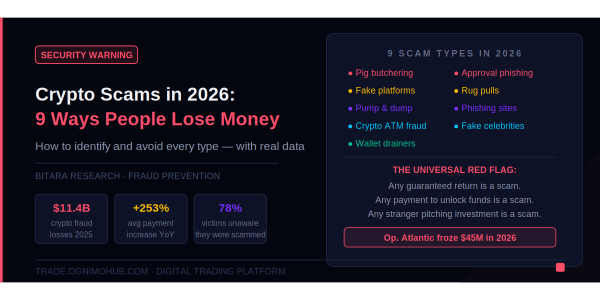
Crypto Scams in 2026: The 9 Most Common Ways People Lose Money and How to Avoid Every One
By Bitara Research · June 2026 · 13 min read
The Numbers Are Worse Than You Think
The FBI's 2025 Internet Crime Report, released in April 2026, logged $11.366 billion in cryptocurrency-related fraud losses in 2025 — a 22% increase year-on-year across 181,565 complaints. The average scam payment increased from $782 in 2024 to $2,764 in 2025, a 253% increase. Pig-butchering investment fraud alone accounted for $7.228 billion.
More revealing: the FBI's Operation Level Up contacted 3,780 victims of cryptocurrency investment fraud in 2025 and found that 78% were completely unaware they were being scammed at the moment of contact. They believed they were profiting. That is what makes modern crypto scams different from the obvious fraud of five years ago. Today's operations are industrialised, psychologically sophisticated, and increasingly powered by artificial intelligence.
This guide gives you a specific, practical understanding of every major scam type operating in 2026 — how they work, what they look like, and the exact red flags that distinguish them from legitimate opportunities. Share it with anyone who is new to crypto.
Scam 1: Pig Butchering — The Most Expensive Scam in Crypto History
How it works: "Pig butchering" — a translation of the Chinese sha zhu pan — refers to the process of fattening a pig before slaughter. In crypto, that means building an emotional relationship with a victim over weeks or months before introducing a fake investment opportunity.
The scammer contacts you through a random message, a dating app, social media, or even a mistaken text. They are friendly, educated, and often claim to be successful in business or finance. The relationship develops slowly — you might talk for weeks before crypto is mentioned. When it is finally introduced, it feels like they are sharing a private opportunity with you as a trusted friend.
They direct you to a fake trading platform that looks professional. Your "investments" show spectacular gains. The dashboard is convincing. When you eventually try to withdraw a significant amount, problems begin — withdrawal fees, taxes, account verification requirements. Every payment you make to resolve the issue is simply more money stolen.
The 2026 evolution: AI voice cloning and deepfake video technology are now used to impersonate real individuals in these relationships, making the deception significantly harder to detect. In March 2026, Operation Atlantic identified over 20,000 cryptocurrency wallet addresses linked to fraud victims across more than 30 countries and disrupted more than 120 web domains involved in these operations.
The red flags:
- Stranger initiates contact with no clear reason (wrong number, random message)
- Relationship accelerates unusually quickly
- Investment platform is not publicly audited or independently verifiable
- Profits are visible but cannot be withdrawn without additional payments
- Any payment described as a "tax," "fee," or "verification" to unlock your funds
The rule: Never invest in any platform introduced through a personal relationship that began online. Legitimate investment opportunities do not come through strangers who messaged you first.
Scam 2: Approval Phishing — The Technical Evolution
How it works: Approval phishing exploits the "approve" transaction function used by decentralised applications on blockchains like Ethereum. When you connect a wallet to a dApp, you sometimes sign an approval transaction that grants the dApp permission to move your tokens.
Scammers create fake websites — fake airdrop claims, fake NFT mints, fake yield farming platforms — that ask you to connect your wallet and sign an approval transaction. You believe you are claiming a reward. You are actually signing away permission for the attacker to drain your wallet at any time.
Unlike traditional phishing that steals passwords, approval phishing exploits legitimate blockchain mechanics. Once you sign the approval, the attacker can drain your wallet at any point in the future — even weeks later. Many victims do not realise they were compromised until they see their balance disappear without warning.
The red flags:
- Any website asking you to "connect wallet" for a free airdrop, prize, or reward
- A transaction that says "approve unlimited spending" for any token
- Any interaction with a smart contract not verified on public explorers like Etherscan
The rule: Before signing any transaction, read exactly what you are approving. Never approve unlimited spending unless you fully understand the contract. Revoke wallet approvals you no longer need through tools like Revoke.cash.
Scam 3: Fake Investment Platforms (High-Yield Investment Scams)
How it works: Scammers build convincing fake trading platforms — complete with charts, order history, live prices, and professional UI. They advertise guaranteed returns of 2–10% daily, which legitimate investments cannot produce. Victims deposit, watch fake profits accumulate, attempt to withdraw, and discover the platform is controlled by the scammers who take all deposits.
Overall scam inflows have surged, particularly through impersonation tactics that saw 1,400% year-on-year growth. The modular, service-based approach — where scammers buy phishing kits and fake platform templates — allows technically unsophisticated criminals to run sophisticated operations, lowering the barrier to entry for crypto fraud enormously.
The red flags:
- Guaranteed daily or weekly returns (no investment guarantees returns)
- Withdrawal requiring additional payments to process
- Platform not listed on any reputable directory or independent review source
- No verifiable physical address, registration, or regulatory licence
- Pressure to recruit others for additional rewards
The rule: There is no such thing as a guaranteed return in crypto. Any platform offering fixed daily returns is a scam. Period.
Scam 4: Rug Pulls
How it works: Developers create a new token, build hype on social media, attract investors, allow the price to rise as buying pressure grows — then sell all their holdings simultaneously ("pull the rug"), causing the price to collapse to near zero. Investors are left with worthless tokens.
Rug pulls range from simple (abandon project immediately after launch) to sophisticated (build apparent utility, cultivate community for months, then exit at peak liquidity).
The red flags:
- Anonymous team with no verifiable identity or professional history
- No smart contract audit from a reputable auditing firm
- Developers hold a large percentage of the total token supply
- Extreme promises about returns with vague technical claims
- Social media hype disproportionate to actual product development
The rule: Before investing in any new token, check: Is the smart contract audited? Do the developers have verifiable identities? Is the liquidity locked? If any of these are absent, the risk of a rug pull is significant.
Scam 5: Pump and Dump Schemes
How it works: Coordinated groups — often operating through Telegram or Discord channels — accumulate a low-liquidity token, then publish aggressive buy signals to followers, driving up the price through manufactured demand. When the price peaks, the coordinators sell their holdings, leaving followers holding tokens that immediately collapse in value.
These operations are often disguised as "trading signals" or "exclusive calls" from apparent experts. The signal providers profit from the dump; the followers absorb the losses.
The red flags:
- Urgent buy calls with short time windows ("buy NOW before it's too late")
- Small market cap tokens with low trading volume being promoted aggressively
- Calls coming from anonymous social media accounts or Telegram groups
- No fundamental analysis — just price targets and urgency
The rule: Any "signal" that requires urgency is designed to make you bypass analysis. Legitimate trading setups do not expire in five minutes.
Scam 6: Phishing — Fake Websites and Emails
How it works: Scammers create near-identical copies of legitimate crypto exchange websites. They drive traffic to these fake sites through search engine ads, email, or social media links. You enter your login credentials. The scammer captures them and logs into your real account.
In 2026, phishing operations are increasingly AI-assisted — personalised emails that reference your name, your exchange, and recent transactions to appear legitimate. Phishing kits are 688 times more effective in dollar terms than unassisted scams.
The red flags:
- URL with slight misspellings (bitara.c0m, bltara.com, bitara-trade.com)
- Email claiming your account needs urgent verification
- Any link to an exchange received in an unsolicited message
- SSL certificate that does not match the domain exactly
The rule: Never click a link to an exchange from an email or message. Always type the exchange URL directly into your browser or use a saved bookmark. Verify the URL character by character before entering credentials.
Scam 7: Crypto ATM Scams
How it works: Scammers impersonate government officials, bank fraud departments, or tech support — claiming your account has been compromised or you owe a fine. They instruct you to withdraw cash from your bank and deposit it into a crypto ATM, which sends the funds to a scammer-controlled wallet.
Between January and November 2025, losses from crypto ATM scams reached $333.5 million. More than 85% of reported losses were by adults over 60. The impersonation of government agencies and banks gives the scam a veneer of authority that bypasses normal scepticism.
The red flags:
- Any government agency, bank, or utility company directing you to a crypto ATM
- Being told to keep the transaction secret
- Urgency — "you must do this now or face arrest/account closure"
The rule: No legitimate government agency, bank, or company will ever instruct you to pay using cryptocurrency through an ATM. This is a scam without exception.
Scam 8: Fake Celebrity Endorsements and Giveaway Scams
How it works: Scammers create fake accounts or deepfake videos impersonating famous investors, tech figures, or crypto personalities, claiming that sending a specific amount of crypto will result in receiving double back. They create urgency and social proof through fake comments and follower counts.
AI-powered scams generated $893 million in losses in 2025 alone, with deepfake voice cloning and fake celebrity endorsements among the primary vehicles.
The red flags:
- Any offer to "double" your crypto by sending it first
- Celebrity accounts with small discrepancies in the username (extra underscore, slight misspelling)
- Comments on the post that all look like endorsements from real people (bot-generated)
The rule: No legitimate giveaway requires you to send crypto first. Every single "send X and receive 2X" offer is a scam. Every one.
Scam 9: Wallet Drainer Malware
How it works: Malicious software installed on your device — often through fake browser extensions, fake wallet apps, or cracked software — monitors your clipboard for cryptocurrency addresses. When you copy an address to paste for a withdrawal, the malware silently replaces it with the attacker's address. You paste, confirm, and send funds directly to the scammer.
The red flags:
- Downloading crypto wallets or extensions from any source other than the official website
- Browser extensions requesting permissions they do not need (reading clipboard, accessing all websites)
- Clipboard content that differs from what you copied
The rule: Always compare the first 6 and last 6 characters of a pasted address with the source. Install browser extensions only from verified developer sources. Use antivirus software and keep it updated.
The Universal Red Flag Checklist
Print this. Check every interaction against it:
✗ Guaranteed returns or minimum profit promises
✗ Urgency — "act now," "limited time," "before it's too late"
✗ Requests for payment to unlock, verify, or release funds you are owed
✗ Contact initiated by a stranger who gradually introduces an investment opportunity
✗ Platform not independently audited or publicly verifiable
✗ Anonymous team with no professional history
✗ Any offer that requires you to send crypto first to receive more
✗ Someone asking for your seed phrase, password, or 2FA codes (no one ever legitimately needs these)
✗ Pressure to keep the investment secret
✗ Returns that seem too high to be real (they are)
If any single item on this list is present, stop. Do not proceed.
What to Do If You Have Been Scammed
Stop sending money immediately. The most common manipulation is convincing victims that one more payment will unlock their funds. It never does.
Document everything. Screenshots, transaction IDs, wallet addresses, chat logs, email correspondence. You will need all of this for any report.
Report to authorities. In the United States, report to the FBI's IC3 at ic3.gov. In the UK, to Action Fraud. In Nigeria, to the EFCC. In Kenya, to the DCI. In South Africa, to the SAPS Cybercrime Unit. International coordination is increasing — reports contribute to operations like Atlantic.
Contact Bitara support immediately if the fraud involved your Bitara account or a counterparty on Bitara's P2P marketplace. The escrow system provides protection when used correctly — document any instance where a counterparty asked you to transact outside the platform.
Seek support. The psychological impact of being scammed — particularly pig-butchering scams that exploit genuine emotional relationships — is significant. Victim support organisations including Global Anti-Scam Organization (globalantiscam.org) provide resources and community support.
Disclaimer: This content is for informational purposes only. If you believe you are experiencing a financial crime, contact local law enforcement. Trade on regulated, licensed platforms with escrow protection.
Share This Post
By Bitara Research · June 2026 · 13 min read
The Numbers Are Worse Than You Think
The FBI's 2025 Internet Crime Report, released in April 2026, logged $11.366 billion in cryptocurrency-related fraud losses in 2025 — a 22% increase year-on-year across 181,565 complaints. The average scam payment increased from $782 in 2024 to $2,764 in 2025, a 253% increase. Pig-butchering investment fraud alone accounted for $7.228 billion.
More revealing: the FBI's Operation Level Up contacted 3,780 victims of cryptocurrency investment fraud in 2025 and found that 78% were completely unaware they were being scammed at the moment of contact. They believed they were profiting. That is what makes modern crypto scams different from the obvious fraud of five years ago. Today's operations are industrialised, psychologically sophisticated, and increasingly powered by artificial intelligence.
This guide gives you a specific, practical understanding of every major scam type operating in 2026 — how they work, what they look like, and the exact red flags that distinguish them from legitimate opportunities. Share it with anyone who is new to crypto.
Scam 1: Pig Butchering — The Most Expensive Scam in Crypto History
How it works: "Pig butchering" — a translation of the Chinese sha zhu pan — refers to the process of fattening a pig before slaughter. In crypto, that means building an emotional relationship with a victim over weeks or months before introducing a fake investment opportunity.
The scammer contacts you through a random message, a dating app, social media, or even a mistaken text. They are friendly, educated, and often claim to be successful in business or finance. The relationship develops slowly — you might talk for weeks before crypto is mentioned. When it is finally introduced, it feels like they are sharing a private opportunity with you as a trusted friend.
They direct you to a fake trading platform that looks professional. Your "investments" show spectacular gains. The dashboard is convincing. When you eventually try to withdraw a significant amount, problems begin — withdrawal fees, taxes, account verification requirements. Every payment you make to resolve the issue is simply more money stolen.
The 2026 evolution: AI voice cloning and deepfake video technology are now used to impersonate real individuals in these relationships, making the deception significantly harder to detect. In March 2026, Operation Atlantic identified over 20,000 cryptocurrency wallet addresses linked to fraud victims across more than 30 countries and disrupted more than 120 web domains involved in these operations.
The red flags:
- Stranger initiates contact with no clear reason (wrong number, random message)
- Relationship accelerates unusually quickly
- Investment platform is not publicly audited or independently verifiable
- Profits are visible but cannot be withdrawn without additional payments
- Any payment described as a "tax," "fee," or "verification" to unlock your funds
The rule: Never invest in any platform introduced through a personal relationship that began online. Legitimate investment opportunities do not come through strangers who messaged you first.
Scam 2: Approval Phishing — The Technical Evolution
How it works: Approval phishing exploits the "approve" transaction function used by decentralised applications on blockchains like Ethereum. When you connect a wallet to a dApp, you sometimes sign an approval transaction that grants the dApp permission to move your tokens.
Scammers create fake websites — fake airdrop claims, fake NFT mints, fake yield farming platforms — that ask you to connect your wallet and sign an approval transaction. You believe you are claiming a reward. You are actually signing away permission for the attacker to drain your wallet at any time.
Unlike traditional phishing that steals passwords, approval phishing exploits legitimate blockchain mechanics. Once you sign the approval, the attacker can drain your wallet at any point in the future — even weeks later. Many victims do not realise they were compromised until they see their balance disappear without warning.
The red flags:
- Any website asking you to "connect wallet" for a free airdrop, prize, or reward
- A transaction that says "approve unlimited spending" for any token
- Any interaction with a smart contract not verified on public explorers like Etherscan
The rule: Before signing any transaction, read exactly what you are approving. Never approve unlimited spending unless you fully understand the contract. Revoke wallet approvals you no longer need through tools like Revoke.cash.
Scam 3: Fake Investment Platforms (High-Yield Investment Scams)
How it works: Scammers build convincing fake trading platforms — complete with charts, order history, live prices, and professional UI. They advertise guaranteed returns of 2–10% daily, which legitimate investments cannot produce. Victims deposit, watch fake profits accumulate, attempt to withdraw, and discover the platform is controlled by the scammers who take all deposits.
Overall scam inflows have surged, particularly through impersonation tactics that saw 1,400% year-on-year growth. The modular, service-based approach — where scammers buy phishing kits and fake platform templates — allows technically unsophisticated criminals to run sophisticated operations, lowering the barrier to entry for crypto fraud enormously.
The red flags:
- Guaranteed daily or weekly returns (no investment guarantees returns)
- Withdrawal requiring additional payments to process
- Platform not listed on any reputable directory or independent review source
- No verifiable physical address, registration, or regulatory licence
- Pressure to recruit others for additional rewards
The rule: There is no such thing as a guaranteed return in crypto. Any platform offering fixed daily returns is a scam. Period.
Scam 4: Rug Pulls
How it works: Developers create a new token, build hype on social media, attract investors, allow the price to rise as buying pressure grows — then sell all their holdings simultaneously ("pull the rug"), causing the price to collapse to near zero. Investors are left with worthless tokens.
Rug pulls range from simple (abandon project immediately after launch) to sophisticated (build apparent utility, cultivate community for months, then exit at peak liquidity).
The red flags:
- Anonymous team with no verifiable identity or professional history
- No smart contract audit from a reputable auditing firm
- Developers hold a large percentage of the total token supply
- Extreme promises about returns with vague technical claims
- Social media hype disproportionate to actual product development
The rule: Before investing in any new token, check: Is the smart contract audited? Do the developers have verifiable identities? Is the liquidity locked? If any of these are absent, the risk of a rug pull is significant.
Scam 5: Pump and Dump Schemes
How it works: Coordinated groups — often operating through Telegram or Discord channels — accumulate a low-liquidity token, then publish aggressive buy signals to followers, driving up the price through manufactured demand. When the price peaks, the coordinators sell their holdings, leaving followers holding tokens that immediately collapse in value.
These operations are often disguised as "trading signals" or "exclusive calls" from apparent experts. The signal providers profit from the dump; the followers absorb the losses.
The red flags:
- Urgent buy calls with short time windows ("buy NOW before it's too late")
- Small market cap tokens with low trading volume being promoted aggressively
- Calls coming from anonymous social media accounts or Telegram groups
- No fundamental analysis — just price targets and urgency
The rule: Any "signal" that requires urgency is designed to make you bypass analysis. Legitimate trading setups do not expire in five minutes.
Scam 6: Phishing — Fake Websites and Emails
How it works: Scammers create near-identical copies of legitimate crypto exchange websites. They drive traffic to these fake sites through search engine ads, email, or social media links. You enter your login credentials. The scammer captures them and logs into your real account.
In 2026, phishing operations are increasingly AI-assisted — personalised emails that reference your name, your exchange, and recent transactions to appear legitimate. Phishing kits are 688 times more effective in dollar terms than unassisted scams.
The red flags:
- URL with slight misspellings (bitara.c0m, bltara.com, bitara-trade.com)
- Email claiming your account needs urgent verification
- Any link to an exchange received in an unsolicited message
- SSL certificate that does not match the domain exactly
The rule: Never click a link to an exchange from an email or message. Always type the exchange URL directly into your browser or use a saved bookmark. Verify the URL character by character before entering credentials.
Scam 7: Crypto ATM Scams
How it works: Scammers impersonate government officials, bank fraud departments, or tech support — claiming your account has been compromised or you owe a fine. They instruct you to withdraw cash from your bank and deposit it into a crypto ATM, which sends the funds to a scammer-controlled wallet.
Between January and November 2025, losses from crypto ATM scams reached $333.5 million. More than 85% of reported losses were by adults over 60. The impersonation of government agencies and banks gives the scam a veneer of authority that bypasses normal scepticism.
The red flags:
- Any government agency, bank, or utility company directing you to a crypto ATM
- Being told to keep the transaction secret
- Urgency — "you must do this now or face arrest/account closure"
The rule: No legitimate government agency, bank, or company will ever instruct you to pay using cryptocurrency through an ATM. This is a scam without exception.
Scam 8: Fake Celebrity Endorsements and Giveaway Scams
How it works: Scammers create fake accounts or deepfake videos impersonating famous investors, tech figures, or crypto personalities, claiming that sending a specific amount of crypto will result in receiving double back. They create urgency and social proof through fake comments and follower counts.
AI-powered scams generated $893 million in losses in 2025 alone, with deepfake voice cloning and fake celebrity endorsements among the primary vehicles.
The red flags:
- Any offer to "double" your crypto by sending it first
- Celebrity accounts with small discrepancies in the username (extra underscore, slight misspelling)
- Comments on the post that all look like endorsements from real people (bot-generated)
The rule: No legitimate giveaway requires you to send crypto first. Every single "send X and receive 2X" offer is a scam. Every one.
Scam 9: Wallet Drainer Malware
How it works: Malicious software installed on your device — often through fake browser extensions, fake wallet apps, or cracked software — monitors your clipboard for cryptocurrency addresses. When you copy an address to paste for a withdrawal, the malware silently replaces it with the attacker's address. You paste, confirm, and send funds directly to the scammer.
The red flags:
- Downloading crypto wallets or extensions from any source other than the official website
- Browser extensions requesting permissions they do not need (reading clipboard, accessing all websites)
- Clipboard content that differs from what you copied
The rule: Always compare the first 6 and last 6 characters of a pasted address with the source. Install browser extensions only from verified developer sources. Use antivirus software and keep it updated.
The Universal Red Flag Checklist
Print this. Check every interaction against it:
✗ Guaranteed returns or minimum profit promises ✗ Urgency — "act now," "limited time," "before it's too late" ✗ Requests for payment to unlock, verify, or release funds you are owed ✗ Contact initiated by a stranger who gradually introduces an investment opportunity ✗ Platform not independently audited or publicly verifiable ✗ Anonymous team with no professional history ✗ Any offer that requires you to send crypto first to receive more ✗ Someone asking for your seed phrase, password, or 2FA codes (no one ever legitimately needs these) ✗ Pressure to keep the investment secret ✗ Returns that seem too high to be real (they are)
If any single item on this list is present, stop. Do not proceed.
What to Do If You Have Been Scammed
Stop sending money immediately. The most common manipulation is convincing victims that one more payment will unlock their funds. It never does.
Document everything. Screenshots, transaction IDs, wallet addresses, chat logs, email correspondence. You will need all of this for any report.
Report to authorities. In the United States, report to the FBI's IC3 at ic3.gov. In the UK, to Action Fraud. In Nigeria, to the EFCC. In Kenya, to the DCI. In South Africa, to the SAPS Cybercrime Unit. International coordination is increasing — reports contribute to operations like Atlantic.
Contact Bitara support immediately if the fraud involved your Bitara account or a counterparty on Bitara's P2P marketplace. The escrow system provides protection when used correctly — document any instance where a counterparty asked you to transact outside the platform.
Seek support. The psychological impact of being scammed — particularly pig-butchering scams that exploit genuine emotional relationships — is significant. Victim support organisations including Global Anti-Scam Organization (globalantiscam.org) provide resources and community support.
Disclaimer: This content is for informational purposes only. If you believe you are experiencing a financial crime, contact local law enforcement. Trade on regulated, licensed platforms with escrow protection.