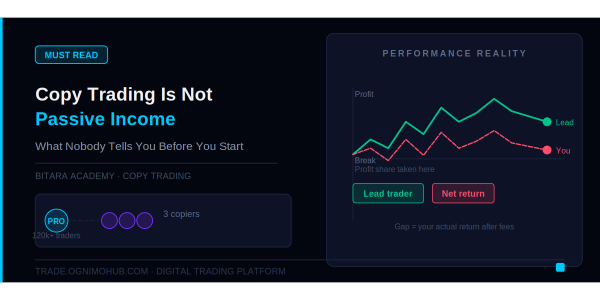
Copy Trading Is Not Passive Income — Here's What Nobody Tells You Before You Start
By Bitara Academy · May 2026 · 10 min read
The Promise vs. The Reality
Copy trading is one of the most searched topics in crypto right now. The pitch is seductive: find a top-performing trader, allocate some capital, and watch your account grow while you sleep. No charts. No 3 AM stress. No need to understand technical analysis.
The reality is more complicated — and if you don't understand the mechanics before you start, you will almost certainly be disappointed.
This is not an article to discourage you from copy trading. Used correctly, it is a genuinely powerful tool. But there is a significant gap between how copy trading is marketed and how it actually performs in practice. This post closes that gap.
How Copy Trading Actually Works
Copy trading lets you automatically mirror the positions of an experienced "lead trader." When they open a position, the same trade fires proportionally in your account. When they close it, you close it too.
The sizing formula is straightforward:
Your Position Size = (Your Allocated Capital ÷ Lead Trader's Equity) × Lead Trader's Position Size
So if you allocate $500 and the lead trader has $10,000 in their account, and they open a $2,000 BTC position, your account opens a $100 BTC position. Every move they make, you mirror at 5% of their scale.
Simple in theory. The complications begin in practice.
The Four Costs Nobody Mentions Upfront
1. Profit Share (10–30%)
This is the most visible fee. Lead traders typically charge 10–15% of net profit in standard mode, and up to 30% for elite or hedge-fund-style masters. On a $1,000 investment generating $200 gross profit with a 20% profit share, you net $160 before any other costs. That is a meaningful haircut on your returns.
2. Standard Trading Fees on Every Copied Trade
Every trade your account mirrors incurs the standard exchange trading fee — typically 0.1% on spot and 0.02–0.06% on futures. If your lead trader is an active scalper opening 10 positions a day, those fees accumulate quickly against your smaller allocation.
3. Funding Rate Drag on Futures
This is the one that destroys returns for copy traders who don't understand it. In a sustained bull market, perpetual futures funding rates on long BTC and ETH positions run +0.01% to +0.05% every 8 hours. At the median of +0.015%, that is roughly +0.045% per day — approximately 16% annualised funding drag on any leveraged long position held continuously. Your lead trader may be managing this actively. Your mirrored account may not be.
4. Execution Timing Gaps
This is structural and unavoidable. You enter after the lead trader. In fast-moving markets, even a 1–2 second delay can mean a meaningfully worse fill price. When the lead trader catches a breakout at $67,400, you might enter at $67,450. Multiply that across dozens of trades and the performance gap becomes significant.
Why You Almost Always Underperform Your Lead Trader
Data shows that most copy traders underperform their lead traders due to execution delays, fees, and profit sharing. This is not a platform-specific issue — it is baked into how the product works.
There are five mechanisms at play:
Execution timing — followers enter after the lead, always. In volatile conditions, this matters enormously.
Slippage — when a popular lead trader opens a large position, your mirrored order adds to the market impact. The more copiers following the same trader, the worse the collective fills.
Strategy crowding — once a lead trader accumulates thousands of copiers, the strategy degrades. A signal that worked at $50,000 allocation becomes noisy at $5,000,000 aggregate following.
Emotional divergence — the lead trader has skin in the game at their full account size and a track record to protect. You have a small allocation, different emotional pressure, and may panic-stop at the wrong time.
Fee compounding — profit share plus trading fees plus funding drag, compounded over months, creates a structural disadvantage that even a great lead trader's performance struggles to overcome.
The Leaderboard Problem
Every copy trading platform displays a leaderboard. The top traders show eye-catching ROI figures — 200%, 500%, even 1,000% returns. Here is what the leaderboard does not show you:
Survivorship bias. The traders at the top are the ones who got lucky or who took enormous risks that happened to pay off. The hundreds of traders who took the same risks and blew up are not on the leaderboard. They are gone.
Timeframe cherry-picking. A 300% return over 30 days looks spectacular. It may represent 3 large leveraged bets that all hit in a specific bull run window. Ask what happened in the subsequent 30 days.
Drawdown history. The critical number most new copy traders ignore. A trader with 150% ROI and a 70% maximum drawdown is telling you that at some point, following them would have meant watching your capital drop by 70%. Are you prepared for that? Do you have a copy stop-loss set that would exit you before that point?
Focus on consistent traders with moderate returns rather than chasing high-ROI outliers, and always factor fees into your expected net return.
What Actually Works: The Copy Trading Framework
Here is how to approach copy trading on Bitara in a way that gives it a realistic chance of working:
Step 1: Filter by Risk-Adjusted Metrics, Not Raw ROI
Sort lead traders by maximum drawdown first. Any trader with more than 30–40% max drawdown carries significant risk to your capital. Then filter by win rate, consistency of returns over 90+ days, and average trade duration. Short average durations mean frequent trading and more fee exposure.
Step 2: Diversify Across 3–5 Lead Traders
Never allocate 100% of your copy trading capital to one trader. Different lead traders have different strategy profiles — some perform better in trending markets, others in ranging conditions. Diversification smooths your equity curve.
Step 3: Set a Copy Stop-Loss
Every serious copy trading platform allows you to set a maximum loss threshold on a copied account. Set it. A 15–20% copy stop-loss means if your allocation to that trader loses that amount, you exit automatically. This prevents a single bad lead trader from devastating your portfolio.
Step 4: Size Appropriately
A practical minimum for copying 2–3 traders simultaneously is $50–$100 to allow meaningful diversification. With very small amounts, fees and profit sharing eat a larger percentage of returns. With very large amounts, you face the crowding problem. The sweet spot is an allocation where your copied trades are large enough to execute cleanly, but not so large that you become a meaningful percentage of the lead trader's following.
Step 5: Review Monthly, Not Daily
Copy trading performed on a daily check basis leads to panic exits. Set a monthly review schedule. Evaluate lead trader performance against your expectations. Replace traders who show consistent drawdown or strategy drift. Do not react to individual trades.
When Copy Trading Makes Sense
Copy trading genuinely adds value in specific situations:
You have limited time but want market exposure during confirmed bull cycles. Copy trading a conservative spot trader during a bull run is a reasonable strategy for a busy professional.
You are learning — shadowing a good lead trader is an education tool. Watching when and why they enter and exit positions teaches market structure better than any course.
You want diversified exposure across trading styles you do not have time to execute personally — a scalper, a swing trader, and a macro trader operating simultaneously.
You understand it is not passive. Copy trading requires periodic oversight, trader assessment, and active risk management settings. It is semi-automated, not hands-off.
When Copy Trading Does NOT Make Sense
If you are chasing someone with 500% ROI and a 60% drawdown. You will likely join at the peak of their performance and experience the drawdown in full.
If you have not set a copy stop-loss. Without it, a single blow-up lead trader can take a large portion of your capital with them.
If you expect it to replace active trading knowledge. Copy trading is risk transfer, not risk removal. You are borrowing someone else's decisions, but the profits are not guaranteed and the losses still land in your account.
If you are using leverage through copy trading without understanding funding rates. Futures copy trading with leverage during high funding rate environments can erode capital even when the underlying trade is directionally correct.
The Bitara Advantage for Copy Traders
On Bitara, copy trading sits alongside spot, futures, binary, and P2P — which means your copy trading capital is part of a broader strategy, not your entire exposure. The most effective approach is using copy trading for a defined portion of your portfolio — say 30–40% — while maintaining direct trading positions in assets you have conviction in.
Real-world data shows average monthly returns of 5–15% for well-managed copy trading accounts following consistent lead traders. That is not the 500% leaderboard number. But compounded over 12 months, 5–10% monthly is a powerful return — and it is achievable without the blow-up risk of chasing outlier performers.
The Bottom Line
Copy trading is a legitimate tool. It is not passive income — it is semi-automated trading that requires smart setup, periodic oversight, and realistic expectations. The traders who succeed with it treat it like a managed portfolio sub-allocation, not a slot machine.
Understand the fee stack before you start. Filter by drawdown before you filter by ROI. Diversify across lead traders. Set stop-losses. Review monthly.
Done right, copy trading on Bitara is one of the most efficient ways to participate in crypto markets during busy periods of your life. Done wrong — chasing leaderboard numbers without understanding the mechanics — it is one of the fastest ways to lose capital to fees, drawdowns, and timing gaps.
Now you know the difference.
Share This Post
By Bitara Academy · May 2026 · 10 min read
The Promise vs. The Reality
Copy trading is one of the most searched topics in crypto right now. The pitch is seductive: find a top-performing trader, allocate some capital, and watch your account grow while you sleep. No charts. No 3 AM stress. No need to understand technical analysis.
The reality is more complicated — and if you don't understand the mechanics before you start, you will almost certainly be disappointed.
This is not an article to discourage you from copy trading. Used correctly, it is a genuinely powerful tool. But there is a significant gap between how copy trading is marketed and how it actually performs in practice. This post closes that gap.
How Copy Trading Actually Works
Copy trading lets you automatically mirror the positions of an experienced "lead trader." When they open a position, the same trade fires proportionally in your account. When they close it, you close it too.
The sizing formula is straightforward:
Your Position Size = (Your Allocated Capital ÷ Lead Trader's Equity) × Lead Trader's Position Size
So if you allocate $500 and the lead trader has $10,000 in their account, and they open a $2,000 BTC position, your account opens a $100 BTC position. Every move they make, you mirror at 5% of their scale.
Simple in theory. The complications begin in practice.
The Four Costs Nobody Mentions Upfront
1. Profit Share (10–30%)
This is the most visible fee. Lead traders typically charge 10–15% of net profit in standard mode, and up to 30% for elite or hedge-fund-style masters. On a $1,000 investment generating $200 gross profit with a 20% profit share, you net $160 before any other costs. That is a meaningful haircut on your returns.
2. Standard Trading Fees on Every Copied Trade
Every trade your account mirrors incurs the standard exchange trading fee — typically 0.1% on spot and 0.02–0.06% on futures. If your lead trader is an active scalper opening 10 positions a day, those fees accumulate quickly against your smaller allocation.
3. Funding Rate Drag on Futures
This is the one that destroys returns for copy traders who don't understand it. In a sustained bull market, perpetual futures funding rates on long BTC and ETH positions run +0.01% to +0.05% every 8 hours. At the median of +0.015%, that is roughly +0.045% per day — approximately 16% annualised funding drag on any leveraged long position held continuously. Your lead trader may be managing this actively. Your mirrored account may not be.
4. Execution Timing Gaps
This is structural and unavoidable. You enter after the lead trader. In fast-moving markets, even a 1–2 second delay can mean a meaningfully worse fill price. When the lead trader catches a breakout at $67,400, you might enter at $67,450. Multiply that across dozens of trades and the performance gap becomes significant.
Why You Almost Always Underperform Your Lead Trader
Data shows that most copy traders underperform their lead traders due to execution delays, fees, and profit sharing. This is not a platform-specific issue — it is baked into how the product works.
There are five mechanisms at play:
Execution timing — followers enter after the lead, always. In volatile conditions, this matters enormously.
Slippage — when a popular lead trader opens a large position, your mirrored order adds to the market impact. The more copiers following the same trader, the worse the collective fills.
Strategy crowding — once a lead trader accumulates thousands of copiers, the strategy degrades. A signal that worked at $50,000 allocation becomes noisy at $5,000,000 aggregate following.
Emotional divergence — the lead trader has skin in the game at their full account size and a track record to protect. You have a small allocation, different emotional pressure, and may panic-stop at the wrong time.
Fee compounding — profit share plus trading fees plus funding drag, compounded over months, creates a structural disadvantage that even a great lead trader's performance struggles to overcome.
The Leaderboard Problem
Every copy trading platform displays a leaderboard. The top traders show eye-catching ROI figures — 200%, 500%, even 1,000% returns. Here is what the leaderboard does not show you:
Survivorship bias. The traders at the top are the ones who got lucky or who took enormous risks that happened to pay off. The hundreds of traders who took the same risks and blew up are not on the leaderboard. They are gone.
Timeframe cherry-picking. A 300% return over 30 days looks spectacular. It may represent 3 large leveraged bets that all hit in a specific bull run window. Ask what happened in the subsequent 30 days.
Drawdown history. The critical number most new copy traders ignore. A trader with 150% ROI and a 70% maximum drawdown is telling you that at some point, following them would have meant watching your capital drop by 70%. Are you prepared for that? Do you have a copy stop-loss set that would exit you before that point?
Focus on consistent traders with moderate returns rather than chasing high-ROI outliers, and always factor fees into your expected net return.
What Actually Works: The Copy Trading Framework
Here is how to approach copy trading on Bitara in a way that gives it a realistic chance of working:
Step 1: Filter by Risk-Adjusted Metrics, Not Raw ROI
Sort lead traders by maximum drawdown first. Any trader with more than 30–40% max drawdown carries significant risk to your capital. Then filter by win rate, consistency of returns over 90+ days, and average trade duration. Short average durations mean frequent trading and more fee exposure.
Step 2: Diversify Across 3–5 Lead Traders
Never allocate 100% of your copy trading capital to one trader. Different lead traders have different strategy profiles — some perform better in trending markets, others in ranging conditions. Diversification smooths your equity curve.
Step 3: Set a Copy Stop-Loss
Every serious copy trading platform allows you to set a maximum loss threshold on a copied account. Set it. A 15–20% copy stop-loss means if your allocation to that trader loses that amount, you exit automatically. This prevents a single bad lead trader from devastating your portfolio.
Step 4: Size Appropriately
A practical minimum for copying 2–3 traders simultaneously is $50–$100 to allow meaningful diversification. With very small amounts, fees and profit sharing eat a larger percentage of returns. With very large amounts, you face the crowding problem. The sweet spot is an allocation where your copied trades are large enough to execute cleanly, but not so large that you become a meaningful percentage of the lead trader's following.
Step 5: Review Monthly, Not Daily
Copy trading performed on a daily check basis leads to panic exits. Set a monthly review schedule. Evaluate lead trader performance against your expectations. Replace traders who show consistent drawdown or strategy drift. Do not react to individual trades.
When Copy Trading Makes Sense
Copy trading genuinely adds value in specific situations:
You have limited time but want market exposure during confirmed bull cycles. Copy trading a conservative spot trader during a bull run is a reasonable strategy for a busy professional.
You are learning — shadowing a good lead trader is an education tool. Watching when and why they enter and exit positions teaches market structure better than any course.
You want diversified exposure across trading styles you do not have time to execute personally — a scalper, a swing trader, and a macro trader operating simultaneously.
You understand it is not passive. Copy trading requires periodic oversight, trader assessment, and active risk management settings. It is semi-automated, not hands-off.
When Copy Trading Does NOT Make Sense
If you are chasing someone with 500% ROI and a 60% drawdown. You will likely join at the peak of their performance and experience the drawdown in full.
If you have not set a copy stop-loss. Without it, a single blow-up lead trader can take a large portion of your capital with them.
If you expect it to replace active trading knowledge. Copy trading is risk transfer, not risk removal. You are borrowing someone else's decisions, but the profits are not guaranteed and the losses still land in your account.
If you are using leverage through copy trading without understanding funding rates. Futures copy trading with leverage during high funding rate environments can erode capital even when the underlying trade is directionally correct.
The Bitara Advantage for Copy Traders
On Bitara, copy trading sits alongside spot, futures, binary, and P2P — which means your copy trading capital is part of a broader strategy, not your entire exposure. The most effective approach is using copy trading for a defined portion of your portfolio — say 30–40% — while maintaining direct trading positions in assets you have conviction in.
Real-world data shows average monthly returns of 5–15% for well-managed copy trading accounts following consistent lead traders. That is not the 500% leaderboard number. But compounded over 12 months, 5–10% monthly is a powerful return — and it is achievable without the blow-up risk of chasing outlier performers.
The Bottom Line
Copy trading is a legitimate tool. It is not passive income — it is semi-automated trading that requires smart setup, periodic oversight, and realistic expectations. The traders who succeed with it treat it like a managed portfolio sub-allocation, not a slot machine.
Understand the fee stack before you start. Filter by drawdown before you filter by ROI. Diversify across lead traders. Set stop-losses. Review monthly.
Done right, copy trading on Bitara is one of the most efficient ways to participate in crypto markets during busy periods of your life. Done wrong — chasing leaderboard numbers without understanding the mechanics — it is one of the fastest ways to lose capital to fees, drawdowns, and timing gaps.
Now you know the difference.